

Most indie founders I talk to are running the same mental model they started with on day one: keep costs low, charge enough to cover expenses, and reinvest the rest. That’s a fine place to start, but it breaks down fast once you hit $5K–$10K MRR and start feeling the pull of “maybe I should hire someone” or “maybe I should spend more on ads.” The decisions you make in that window — between scrappy early traction and something that actually feels like a business — will determine whether you stay profitable or accidentally become a startup that needs outside money to survive.
Here’s what I’ve learned from running a bootstrapped SaaS for the past four years, watching dozens of other indie founders navigate the same stretch, and studying the operating playbooks of companies like Basecamp, Transistor.fm, and Plausible Analytics that have stayed small, profitable, and stubbornly independent.
Know Your Real Break-Even — Down to the Dollar
Before you make any growth decision, you need to know your actual monthly burn. Not a rough estimate. Not “around $3K.” The exact number.
Here’s the exercise: open your bank statements for the last three months and categorize every outgoing dollar. For most solo bootstrappers, the categories look something like this:
- Infrastructure: hosting, database, CDN, email delivery, monitoring (Render, Fly.io, PlanetScale, Postmark, Sentry — these add up)
- Tools: Stripe fees (2.9% + 30¢ per transaction, which on $10K MRR is roughly $290/month), support software, analytics, email marketing
- Contractors: designers, developers, writers you hire on a project basis
- Your own salary: the amount you actually pay yourself, not what you wish you paid yourself
Add those up. That’s your break-even. Everything above it is profit. Everything below it is a crisis.
When I ran this exercise at $8K MRR, I discovered I was spending $1,100/month on tools I’d signed up for and mostly forgotten. Cutting that to $400 didn’t require any product changes — just thirty minutes of cancellation emails. That’s $700/month in pure margin improvement, or $8,400/year, without acquiring a single new customer.
The point isn’t to be cheap. The point is to know what you’re working with so you can make real decisions.
The 40% Margin Floor
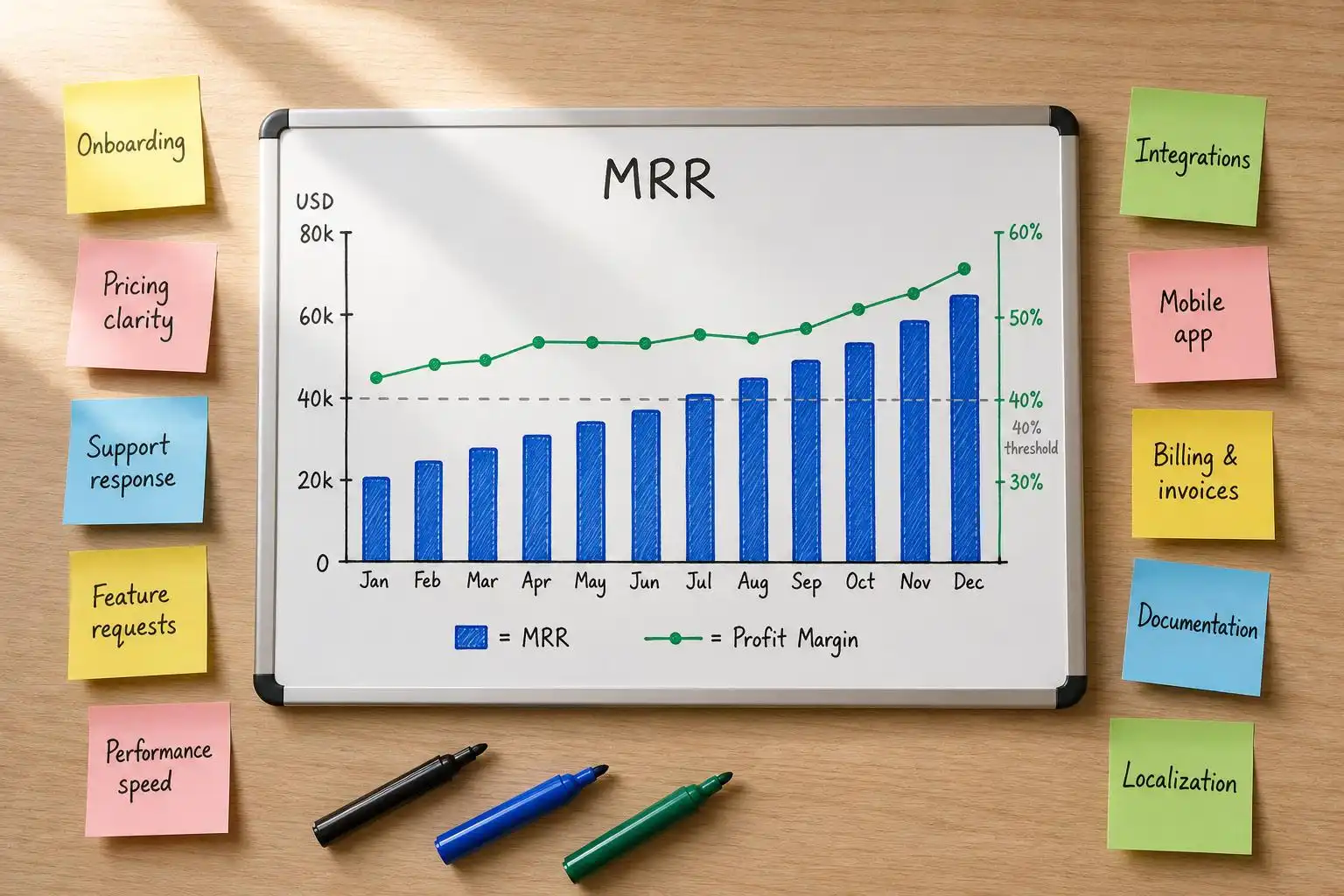
Here’s the rule I use and recommend: never let your net margin drop below 40% of MRR for more than 90 days.
At $10K MRR, that means you’re keeping at least $4K/month after all expenses including your salary. At $20K MRR, that’s $8K/month. This isn’t arbitrary — it’s the buffer that lets you survive a bad month (a churned enterprise customer, an unexpected infrastructure bill, a contractor invoice that came in late), invest in product without panic, and avoid the trap of needing revenue to grow revenue.
When you’re below 40%, you’re not running a business — you’re running a treadmill. Every new customer just pays for the cost of getting the next one.
Transistor.fm, the podcast hosting platform run by Justin Jackson and Jon Buda, has talked publicly about keeping their team tiny (two founders, a handful of contractors) specifically to protect margin. They crossed $1M ARR with that structure. The margin discipline isn’t a constraint on growth — it’s what makes growth sustainable without external capital.
Customer-Funded Development: The Only R&D Budget That Makes Sense
Venture-backed companies build features based on roadmaps approved by investors who want to see growth metrics. Bootstrappers build features based on what customers will pay for. These are very different processes, and the second one is dramatically more capital-efficient.
Here’s the playbook I use for customer-funded development:
Step 1: Identify the feature request with the most paying customers behind it. Not the loudest request — the one most customers have mentioned. In your support inbox, your NPS comments, your churn surveys. If you’re not running exit surveys on churn, start today. Baremetrics has a churn survey tool built in; so does ChurnKey. The data is free, you’re just not collecting it.
Step 2: Price the feature before you build it. This sounds counterintuitive, but it works. Send an email to the customers who’ve requested it: “We’re building [feature]. We’re planning to include it in our [higher tier] plan at $[X]/month. Does that work for you?” If you get a 20%+ positive response rate, build it. If you don’t, either the price is wrong or the feature isn’t as valuable as you thought. Either way, you’ve learned something without writing a line of code.
Step 3: Offer annual prepayment to fund the build. If you need $15K to hire a contractor to build the feature properly, email your most engaged customers and offer them 2 months free in exchange for switching to annual billing. On a $99/month plan, that’s $990 upfront per customer. Fifteen customers gets you $14,850 — essentially the budget for the feature, customer-funded, before you spend a dollar.
Peldi Guilizzoni at Balsamiq has described variations of this approach for years. It’s how you build a product roadmap that’s accountable to revenue, not to a VC’s theory about your market.
Hiring: The Contractor-First Rule
The single most common way bootstrapped founders accidentally blow up their margins is by hiring full-time employees too early. A full-time developer at $90K/year is $7,500/month in salary alone, before benefits, taxes, equipment, and the management overhead of having a direct report. At $15K MRR, that’s 50% of your revenue going to one hire.
The alternative: contractors, scoped projects, and async-first workflows.
My rule is contractor-first until a role clearly needs more than 20 hours/week of consistent, ongoing work that can’t be scoped into discrete projects. In practice, that means I’ve run my business for four years with zero full-time employees other than myself. Design work goes to a freelancer I’ve worked with for three years — she knows the product, I know her rates ($85/hour), and I scope projects in advance so there are no surprises. Development work for larger features goes to a small dev shop I’ve used twice; smaller stuff I handle myself or post on Contra or Toptal.
The math: I spent $34,000 on contractors last year. A single mid-level full-time hire would have cost $110,000–$130,000 all-in. The $76,000–$96,000 difference stayed in the business as profit and runway.
The tradeoff is real: contractors are slower to context-switch, you can’t ask them to pivot on a Tuesday afternoon, and building deep institutional knowledge takes longer. But for a bootstrapped business under $500K ARR, those tradeoffs are almost always worth it.
Churn Is the Leak in Your Bucket — Fix It Before You Add More Water
A lot of indie founders spend all their energy on acquisition and treat churn as an inevitable cost of doing business. It’s not. Churn is a solvable problem, and fixing it is almost always more capital-efficient than acquiring new customers.
Here’s the math: at $20K MRR with 3% monthly churn, you’re losing $600/month in revenue. Over a year, that’s $7,200 in lost ARR. To replace that with new customers at a $99/month price point, you need to acquire 73 new customers just to stay flat. At a $200 CAC (reasonable for a bootstrapped SaaS with some content marketing), that’s $14,600 in acquisition spend to replace revenue you already had.
Alternatively: reduce churn from 3% to 1.5%. Same $20K MRR base, but now you’re only losing $300/month. You’ve effectively “earned” $3,600/year without acquiring a single new customer.
The levers that actually move churn for small SaaS products:
- In-app onboarding that gets users to their first “aha moment” in under 10 minutes. If you don’t know what your aha moment is, look at your retained cohorts vs. churned cohorts and find the behavior that separates them. For most B2B tools, it’s completing a core workflow at least once in the first week.
- Proactive check-ins at day 7 and day 30. A personal email (not a drip sequence — an actual email from you) to new customers asking what’s working and what isn’t. This takes 30 minutes a week and has saved more accounts than any feature I’ve ever built.
- Annual plan incentives. Customers on annual plans churn at roughly half the rate of monthly customers. Offer 1–2 months free for switching. The upfront cash is nice; the churn reduction is the real prize.
Plausible Analytics, the privacy-focused Google Analytics alternative, has built a business with reportedly very low churn by obsessing over product quality and staying focused on a narrow use case. They’re not trying to be everything to everyone. That focus keeps customers happy and keeps the support load manageable for a two-person team.
Runway Is Strategy
Here’s the framing that changed how I think about cash: runway isn’t just a safety net. It’s strategic optionality.
When you have 18+ months of runway — meaning your savings plus projected cash flow could sustain the business for 18 months even with zero new revenue — you can make decisions from a position of strength. You can walk away from a bad partnership. You can say no to a customer who wants features that don’t fit your roadmap. You can take a month to rebuild a core part of the product that’s been accumulating technical debt.
When you have 3 months of runway, every decision is made under duress. You take the bad customer. You build the off-roadmap feature. You raise a round on terms you don’t like.
Building runway means treating profit not as a reward but as an operating input. I keep 12 months of break-even expenses in a high-yield savings account (currently earning around 4.5% APY — not nothing). That’s not money I’m hoarding; it’s the asset that lets me run the business without fear.
The target: 12–18 months of runway at all times. If you dip below 6 months, stop all discretionary spending and focus entirely on retention and expansion revenue until you’re back above 12.
The Compounding Effect of Staying Small
There’s a version of this essay that talks about how to scale to $10M ARR. This isn’t that essay.
The bootstrapper’s advantage isn’t scale — it’s durability. A business doing $300K ARR with 60% net margins and a two-person team is generating $180K in annual profit on a structure that can run indefinitely. That’s not a stepping stone to something bigger. For a lot of us, that is the thing.
Basecamp has been running profitably for over 20 years. Brent Simmons has been running NetNewsWire as an indie project for longer than most SaaS companies have existed. These aren’t failure stories — they’re the point.
The compounding effect of staying small is that every efficiency improvement, every point of churn reduction, every new customer at healthy margins goes directly to your bottom line. There’s no investor dilution, no board to answer to, no growth-at-all-costs mandate eating your margin.
Run the numbers on your own business. Find the leak. Fix it before you pour in more water. Build the feature your customers will pay for before you build it. Keep 12 months of runway in the bank. And resist, every single day, the pressure to grow in ways that require you to give up the thing that makes this worth doing in the first place.


Leave a Reply