

There is a structural cost embedded in every AI product built on rented intelligence, and most founders are not talking about it honestly enough. Call it what it is: a token tax. When you build on top of a model you do not own, you pay published API rates that already include the supplier’s margin. The model maker serves its own subscribers at internal cost. You do not get that deal. The effective cost-subsidy ratio between first-party and third-party serving runs roughly 10 to 25 times [1]. That gap is not a temporary market inefficiency. It is the price of building on someone else’s infrastructure, and it shows up directly in your gross margin.
The numbers are not subtle. Traditional SaaS businesses like Salesforce run gross margins around 77%. AI-native products, with real compute costs on every query, land at 50–60% [3]. That is a 20–30 point structural penalty, and it does not go away by growing faster or closing bigger deals. It is baked into the cost of goods. The only way out is to either own the inference stack — a capital-intensive path most founders cannot afford — or to price in a way that aligns your revenue with the actual value you deliver, so that your margins can recover as inference costs fall.
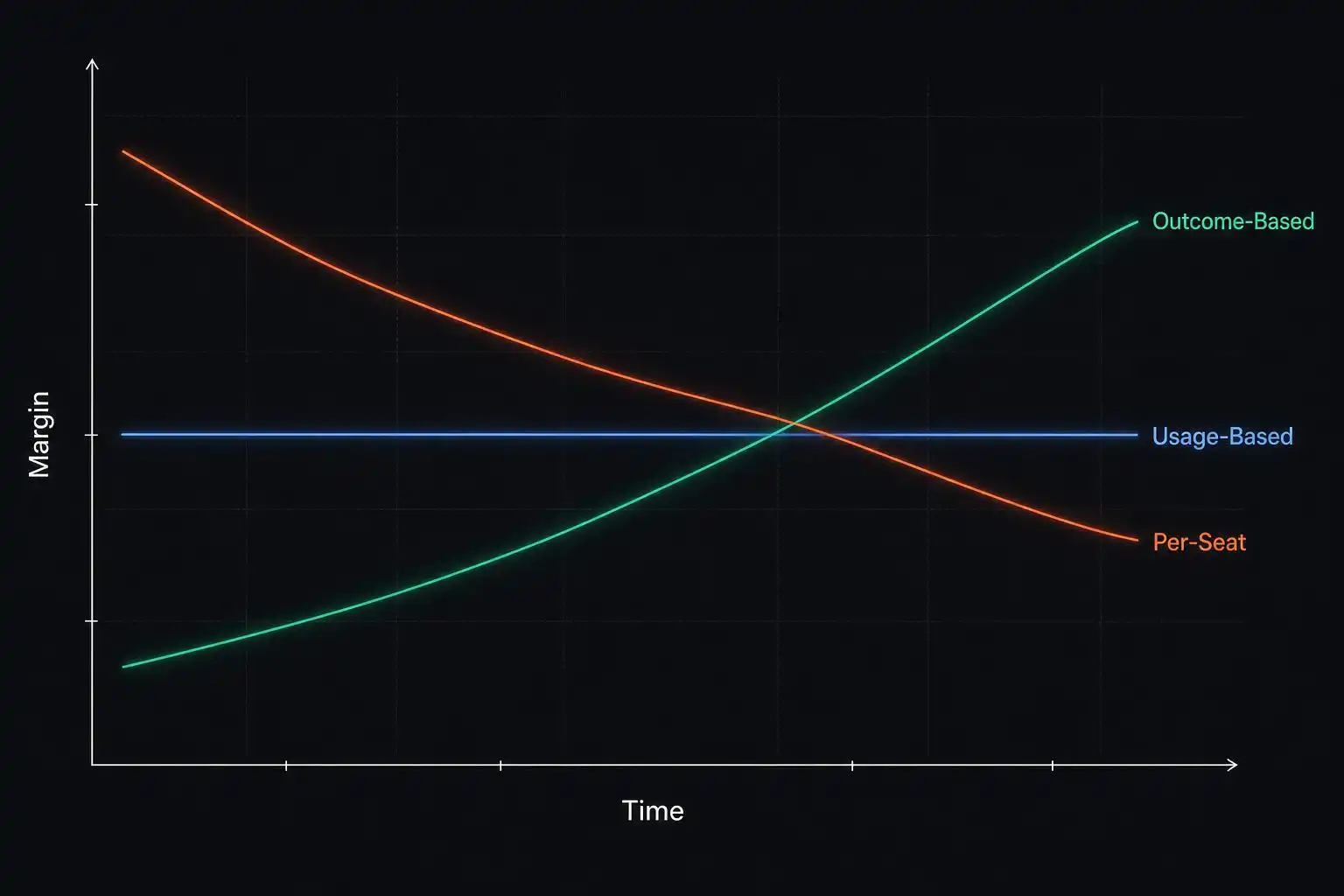
That second path is outcome-based pricing, and it is worth being precise about what it does and does not do.
What Outcome Pricing Actually Solves
Outcome-based pricing charges only when the AI agent delivers a defined, verifiable result. Intercom’s Fin charges $0.99 per resolved support ticket. HubSpot’s Customer Agent dropped to $0.50 per resolved conversation in April 2026 [1]. The customer pays for the resolution, not the token burn it took to get there. That is genuinely useful for buyers: it protects them from the cost swings of a long, runaway agentic session, and it makes the value proposition legible in a way that token counts never can be.
But here is what outcome pricing does not do: it does not make inference cost disappear. It shifts the usage risk from the customer to the vendor [1]. If a ticket resolution costs $1.50 in inference to produce and you sell it for $0.99, you are losing money in a different currency than before, but you are still losing money. Outcome pricing is a discipline. It only pays off when the underlying inference engineering has also been done — when you have built an agent that is efficient enough that each verified resolution is profitable at your published rate.
This is the part most pricing conversations skip. Founders hear “outcome-based pricing” and think it is a positioning move. It is not. It is a margin commitment. You are telling the market: I am confident enough in my cost structure to absorb the inference risk. That confidence either exists or it does not, and the market will eventually find out which.
The Seat-Based Trap
Per-seat pricing made sense when serving an additional user cost nearly nothing. SaaS was built on that assumption. AI inference broke it [2]. When a seat holder runs an agentic workflow that burns thousands of tokens, the cost of that seat is no longer predictable. Companies that held rigidly to seat-based models saw gross margins roughly 40% lower on average than usage or outcome adopters [2]. The per-seat model does not just underperform at scale — it actively misrepresents the cost structure to both the customer and the business.
There is also a subtler trap in seat pricing for agentic products specifically. Agents reduce the number of human seats needed. If your pricing unit is the human seat and your product is replacing human work, you are pricing yourself into irrelevance. Gartner predicts that by 2030, seat-based vendor revenue share will decline from 21% to 15% of enterprise SaaS spend. IDC puts the disruption faster: 70% of software vendors will move away from pure per-seat models by 2028 [3]. The vendors who see this coming are repricing now, while being early still reads as a credibility signal.
The Pricing Ladder Between Seats and Outcomes
Not every product is ready for pure outcome pricing, and that is fine. There is a useful ladder between the seat-based model and the fully outcome-based one.
Per-query pricing abstracts tokens into a unit the user can count — an image generated, a document summarized. The buyer can predict their bill, which fixes the comprehension problem with raw token pricing. The margin risk is that usage skews toward complex tasks that burn more compute per unit than you priced for [2]. This model works when task complexity is relatively uniform.
Credit-based pricing puts a budget in the customer’s hands while protecting your margin, because you set the exchange rate per task. A basic query costs 1 credit; a deep research synthesis costs 50. The unit stays stable for the buyer even as your underlying cost differs by task type [2]. Credits are a useful transitional model when you have variable-cost tasks but are not yet ready to define verifiable outcomes.
Outcome-based pricing carries the highest possible margins and is the hardest to operationalize [2]. The operationalization problem is real: you need a definition of “resolved” that both parties agree on, an instrumentation layer that can verify it, and a cost structure that makes each resolution profitable. Most AI products are not there yet. The ones that are should be moving fast.
Why the Margin Math Gets Better Over Time
Here is the structural tailwind that makes outcome pricing worth committing to now: inference costs have fallen roughly 900 times between 2023 and 2024 [3]. That trend is not slowing. As inference costs approach zero, every outcome-priced product gets more profitable at the same published rate. The vendor who commits to $0.99 per resolution today and engineers the agent to cost $0.40 in inference by year two is running a very different margin profile than the one who stayed on seats.
Replit’s path illustrates the recovery arc: reportedly under 10% gross margin before its pricing changes, climbing to the 20–30% range afterward [2]. Still well below traditional SaaS levels, but the direction is right. The pricing migration improves the margin line; getting back toward pre-AI SaaS levels also requires the inference engineering work — model selection, prompt optimization, caching, routing — that most founders treat as an afterthought.
What Your Pricing Model Signals
The pricing model a company chooses reveals more about its product confidence than its website copy does [3]. Per-seat pricing on an agentic product signals that you are not sure the agent will actually perform consistently enough to stake revenue on it. Usage-based pricing signals that you have cost visibility but have not yet defined what success looks like. Outcome-based pricing signals that you know what you deliver, you can verify it, and you are willing to get paid only when it happens.
That last signal matters enormously in enterprise sales. Buyers are increasingly sophisticated about AI costs. They have seen the token bills from early agentic deployments. When a vendor shows up and says “you pay only when it works,” that is not just a pricing preference — it is a trust mechanism. It is the vendor putting skin in the game.
The founders who will win in the post-seat era are not the ones who find the cleverest way to obscure token costs inside a flat fee. They are the ones who build efficient enough agents to absorb the inference risk, define outcomes clearly enough to verify them, and price in a way that gets better for both sides as the underlying cost structure improves. That is a harder product and business problem than per-seat pricing. It is also the only honest answer to what AI-native software actually costs.


Leave a Reply