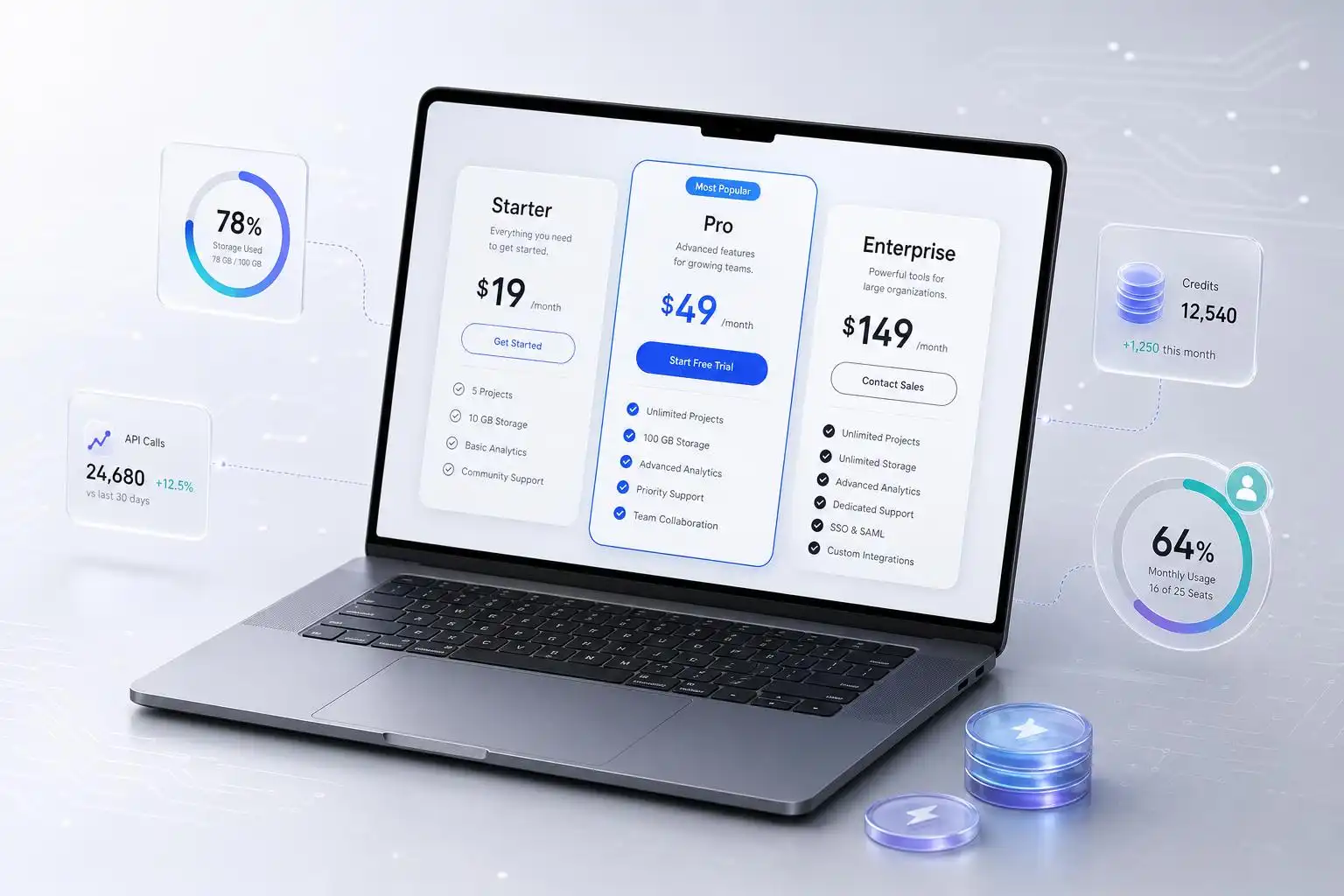

The most useful pricing question in 2026 is not “Should we charge per seat, per token, or per workflow?” It is: “What is the customer actually buying more of when they get more value from us?”
That sounds obvious until you look at the average SaaS pricing page. Many are still built around internal product architecture: seats because the billing system understands users, tiers because the founder can name three plans, credits because AI costs need to go somewhere. But customers do not buy your architecture. They buy reduced labor, faster decisions, more output, less risk, or a new capability they could not afford before.
The pricing model is just the receipt.
And right now, that receipt is getting more complicated. Recent SaaS pricing guides converge on the same point: there are still familiar structures — flat-rate, per-user, tiered, usage-based, freemium, feature-based, and hybrid — but mature companies increasingly combine them rather than choosing one clean model.[1] AI has accelerated that shift because a single seat can now create wildly different cost and value profiles. One user might ask for a weekly summary. Another might run agents overnight, generate thousands of assets, or automate an entire department’s repetitive work.
A seat is no longer a reliable proxy for value. Sometimes it is not even a reliable proxy for cost.
The new default is hybrid — but hybrid is not a strategy
Hybrid pricing is becoming the gravitational center of SaaS: a subscription to anchor the relationship, plus some variable component that expands with usage, volume, credits, contacts, workflows, or outcomes. Source material from SaaStr notes that Replit layered credits on top of flat subscriptions, and that two in three Forbes AI 50 companies now use some form of usage-based pricing, with most running a hybrid model.[5]
That is directionally right. But “hybrid” can mean two very different things:
- A thoughtful value-capture system.
- A subscription plan with a cost pass-through duct-taped onto it.
Buyers can feel the difference.
A good hybrid model says: “Here is the stable package that matches your role, maturity, and required capabilities. As you create more value, your bill scales in a way that feels proportional.”
A bad hybrid model says: “We have margin anxiety, so here is a credit meter.”
The first one helps customers forecast and expand. The second one makes every power user feel like a liability.
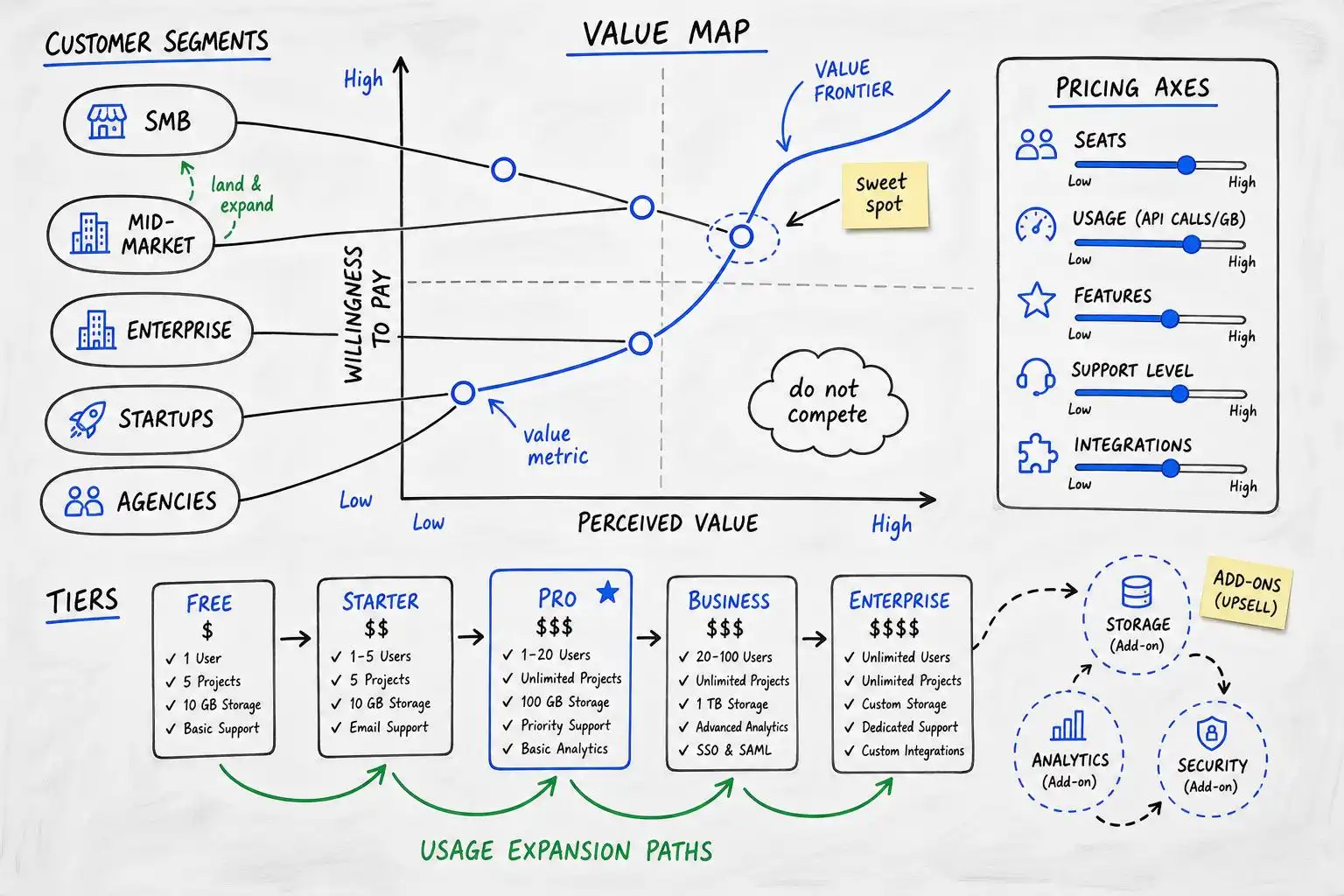
Find the pricing axis before you pick the pricing model
The best line I’ve seen in recent SaaS pricing research is that founders should identify the metric that scales with customer value — the pricing axis — and build around it.[1] That is the work. The model comes after.
A pricing axis might be:
- Seats, if value grows with team adoption.
- Active users, if nominal seats overstate value.
- Contacts, if the system monetizes a database or audience.
- API calls, if value maps to transactions processed.
- Credits, if multiple expensive actions need one abstraction layer.
- Workflows, if automation count mirrors business impact.
- Documents reviewed, tickets resolved, candidates screened, or invoices processed, if the product produces a measurable unit of work.
The trap is choosing the axis that is easiest to meter instead of the one customers believe in.
For example, tokens are measurable. That does not make them intuitive. Most business buyers do not wake up wanting 40 million tokens. They want 400 support tickets resolved, 40 sales call summaries delivered, or 4 hours of analyst work compressed into 10 minutes. If you price on tokens, you may be accurately passing through cost while completely failing to communicate value.
This is why credits have become popular in AI SaaS. Credit-based pricing can translate messy infrastructure inputs into a more flexible commercial unit. Flexprice’s 2026 pricing overview lists credit-based, hybrid, and outcome-based pricing alongside the classic subscription, tiered, seat-based, and usage-based models.[3] That taxonomy reflects what founders are already discovering: AI products often need an abstraction layer between raw model cost and buyer perception.
But credits are only useful if customers can predict what they buy. If a “credit” means one thing on Monday and another after your model routing changes, you have not created a pricing model. You have created a casino.
Tiered pricing still works — when the tiers do real segmentation
The obituary for tiered pricing is premature. Tiers remain one of the clearest ways to package SaaS because they help buyers self-identify: “I am small and cautious,” “I am growing and need leverage,” or “I am large and need governance.”
The problem is not tiers. The problem is fake tiers.
A real tier changes the buying context. It separates segments with different willingness to pay, operating needs, and risk profiles. A fake tier withholds a random feature until the customer pays more.
Good tier boundaries often include:
- Collaboration depth.
- Governance and admin controls.
- Security, compliance, and audit requirements.
- Integration complexity.
- Support expectations.
- Scale limits that map to company growth.
- Automation or AI capacity that maps to meaningful output.
The research is consistent that tiered pricing captures multiple willingness-to-pay levels and creates natural upgrade paths, but it is complex to design and too many tiers produce decision paralysis.[1] Flexprice makes the same practical observation: most working SaaS pricing examples keep tiers to about three.[3]
My rule of thumb: if a buyer cannot understand the difference between two adjacent tiers in five seconds, you do not have segmentation. You have clutter.
The pricing page has to absorb uncertainty
AI and infrastructure-heavy SaaS products now live with two kinds of uncertainty:
- Customer uncertainty: “How much will I use this?”
- Vendor uncertainty: “How expensive will this be to serve?”
If you dump both uncertainties onto the buyer, conversion suffers. If you absorb both yourself, gross margin suffers. Pricing design is the art of deciding which uncertainty belongs where.
This is where shock absorbers matter:
- Include a base subscription so customers know the relationship has a predictable floor.
- Bundle enough usage that normal adoption does not feel punitive.
- Use overages only when incremental value is obvious.
- Offer spend caps, alerts, and admin controls.
- Separate experimentation credits from production usage.
- Let enterprise customers pre-commit for discounts and predictability.
- Publish examples: “A 20-person support team typically uses X credits/month.”
The buyer should never need a spreadsheet and a theology degree to estimate next month’s bill.
This is also a margin discipline issue. Public developer conversations around AI and cloud infrastructure increasingly assume that many SaaS companies will respond to higher infrastructure costs by raising prices rather than doing hard efficiency work.[8] Whether or not that is fair in every case, it captures a real buyer fear: “Am I paying for value, or am I subsidizing your inefficient stack?”
Your pricing page needs to answer that fear before sales does.
Value-based pricing is research, not vibes
Everyone says they want value-based pricing. Fewer founders want to do the work.
Value-based pricing means setting price according to the outcomes and ROI customers receive, not your costs or your competitors’ price points.[2] In practice, that requires customer interviews, willingness-to-pay research, usage analysis, and segmentation. Codevelo’s pricing strategy guide points founders toward interviews, surveys, A/B testing, and conversion monitoring as the mechanisms for learning how customers perceive value.[4]
Here are the interview questions I like:
- What happens if this problem stays unsolved for another six months?
- What budget does this problem currently come out of?
- What manual work, headcount, software, or agency spend does this replace?
- What metric would improve if this product worked perfectly?
- Who notices that improvement?
- At what price would this feel like an obvious yes?
- At what price would you need CFO approval?
- What would make you feel cheated by the pricing model?
That last question is underrated. Pricing is not just math. It is trust architecture.
A practical 2026 packaging pattern
For many B2B SaaS and AI-native products, the strongest pattern right now looks like this:
1. Three core tiers
Use tiers for buyer identity and capability access:
- Starter: individual, small team, or evaluation use.
- Pro/Team: serious workflow adoption and collaboration.
- Business/Enterprise: governance, security, scale, procurement, and support.
Do not create five tiers because you are afraid to make a packaging decision.
2. A value-aligned usage component
Choose the usage metric that customers can connect to value. That may be credits, processed documents, contacts, workflows, generated assets, successful automations, or API volume.
Avoid raw technical units unless your buyer is technical and already thinks that way.
3. Included allowance
Every paid tier should include enough usage for the customer to experience success. If the paid plan feels like buying a printer and then immediately getting punished for ink, you will train customers to conserve instead of adopt.
4. Transparent expansion
Expansion should feel like growth, not a surprise fee. Use clear overage rates, bundles, top-ups, annual commits, or automatic tier recommendations.
5. Enterprise controls
Enterprise pricing is not just “call us.” It is where you package procurement needs: SSO, audit logs, data retention, permissions, admin reporting, legal terms, dedicated support, committed capacity, and custom limits.
Enterprise buyers often pay more because risk management is part of the product.
When not to use usage-based pricing
Usage-based pricing is fashionable, but it is not always right.
Be careful when:
- Customers cannot predict usage.
- Usage spikes are caused by errors or experimentation.
- The unit of usage does not map cleanly to value.
- Heavy users are not necessarily high-value customers.
- Your champions are incentivized to suppress usage to protect budget.
- Procurement requires predictable annual spend.
In those cases, use a hybrid structure: subscription plus generous included usage, pooled credits, caps, or annual commits. The goal is to preserve expansion without making adoption feel dangerous.
One of the quiet advantages of seat-based pricing was emotional simplicity. Buyers understood it. Finance understood it. Customer success understood expansion. If you move away from seats, you need to replace that simplicity with a different kind of clarity.
Your pricing should evolve with the company
Early-stage founders often overbuild pricing before they have enough signal. At MVP stage, simple pricing is usually better. You are trying to learn who buys, why they buy, how they use the product, and what value language resonates. Complexity is easier to add than remove.[1]
As the company matures, pricing should evolve: simple validation pricing, then tiers as segments emerge, then usage components as adoption grows, then enterprise packaging, then expansion-focused pricing designed around lifetime value. That progression is echoed in current pricing strategy guidance.[4]
The mistake is treating pricing as a launch task. Pricing is a product surface. It needs maintenance.
Review it when:
- Your customer mix changes.
- A new segment starts closing faster than expected.
- Heavy users have worse gross margin than light users.
- Expansion revenue is flat despite rising product adoption.
- Sales keeps discounting the same objection.
- Customers ask for a plan that does not exist.
- AI or infrastructure cost changes your serving economics.
- A feature moves from differentiator to table stakes.
A pricing page that was perfect at $1M ARR can quietly become a growth ceiling at $10M.
The founder’s test
Here is the test I use when evaluating a pricing model:
Can a customer look at the pricing page and understand three things?
- Which plan is for them.
- Why they would upgrade.
- How their bill grows as they get more value.
If the answer is yes, the model has a chance.
If the answer is no, you do not have a pricing problem. You have a value communication problem wearing a billing costume.
The winners in 2026 will not be the companies with the trendiest model. They will be the ones that can map price to value, cost to margin, and packaging to buyer psychology — without making the customer feel like they need to audit every click.
Hybrid pricing may be the new default. But clarity is still the conversion engine.
References
[1] SaaS Pricing Models: The Complete Founder’s Guide (2026)
[2] A Complete Guide to SaaS Pricing Models and Strategies
[3] 7 SaaS pricing models: How to choose one and refine … – Flexprice
[4] SaaS Pricing Strategy: How to Choose the Right Pricing Model
[5] How Stripe, Google, Canva, Cloudflare and Higgsfield Are Actually …
[8] Ask HN: Will programmers write more efficient code during the memory shortage?


Leave a Reply