

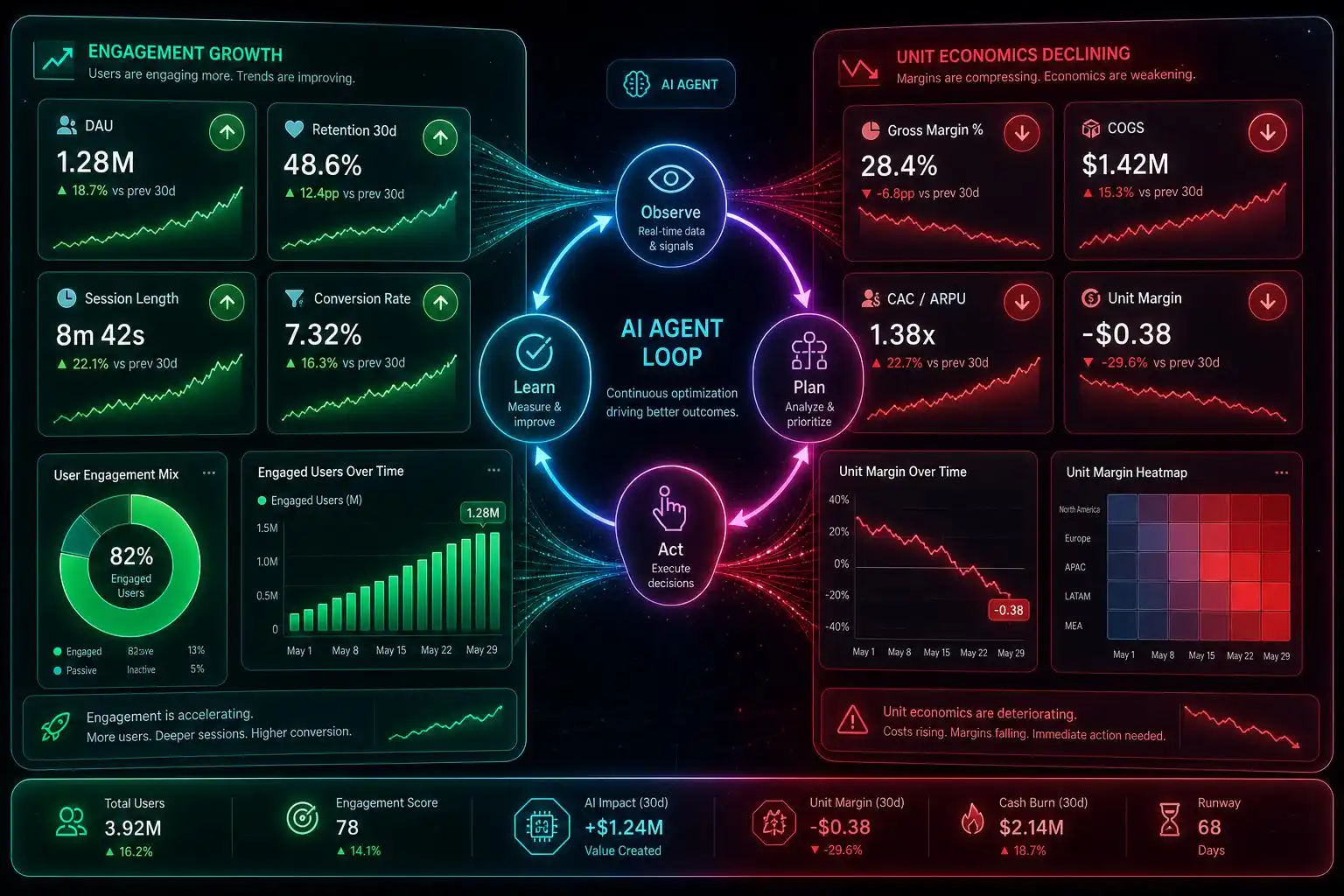
There’s a quiet catastrophe happening on the income statements of AI-native SaaS companies right now, and most founders aren’t seeing it until it’s too late. Engagement metrics look great. Monthly actives are up. The product is working. And somewhere underneath all that green, the margin is hemorrhaging.
The culprit is deceptively simple: you priced a seat, but you’re delivering an agent.
The Math That Breaks Flat Pricing
Here’s the scenario that keeps me up at night on behalf of founders. A $99/month seat looks perfectly healthy when the average user runs around 20 AI actions per month. But suppose 10% of your users run 500 agentic actions a month, and each action costs you roughly $0.50 in inference. That heavy user now costs $250 to serve on a $99 plan — a loss of $150 per user, per month.[2] Ten of those users erase the gross profit you made on dozens of normal customers.
The engagement dashboard stays green. The margin underneath turns red.
This isn’t a hypothetical. GitHub Copilot moved all plans to usage-based billing in mid-2026, after Microsoft was reportedly losing roughly $20 per user per month on a $10 flat plan when heavy users were factored in.[2] Uber’s CTO disclosed that the company burned through its entire 2026 AI budget in four months.[7] These are not edge cases. They are the natural consequence of pricing a fundamentally variable cost product as if it were fixed.
Why Agentic Workloads Are Different
The reason this problem is so vicious is that agentic workloads don’t behave like ordinary software usage. A single agentic task — with its loops, retries, tool-calling, and chained reasoning — can consume on the order of 1,000 times the tokens of a simple chat turn.[2] And the same task can vary several-fold run to run, which means you can’t even price the average away with clever actuarial math.
Context window inflation makes this worse. Large context windows allow massive inputs, and even if only a fraction of the context is useful, the entire input gets billed — inflating and obscuring consumption in ways that are genuinely hard to predict in advance.[1] Add credit abstraction on top — where vendors wrap token costs in an opaque currency layer — and customers can’t answer basic questions about what’s driving their spend, and neither can you.
A flat seat price, in this environment, is an un-reserved insurance policy written against your own power users.[2] You’re the one holding the bag.
The Market Is Already Voting
The data on where pricing is heading is pretty unambiguous. Maxio found that 83% of AI-native SaaS companies already offer usage-based pricing, largely because the underlying cost structure maps naturally to a consumption model.[5] Metronome’s research showed that 77% of the largest software companies use consumption pricing specifically to unlock revenue expansion from existing customers.[5]
Investor sentiment is even more pointed. When surveyed on which pricing model they favor, only 5% of investors said seat-based and 10% said flat-fee subscription. Hybrid models led at 35%, followed by outcome-based at 26% and usage-based at 24%.[5] The money is not flowing toward flat seats. It’s flowing toward models that let revenue expand with value delivered.
Analysts frame it the same way: AI agents shift value delivery from access to actions and outcomes, which forces a new pricing logic on vendors and a new buying logic on customers.[1]
Three Structural Responses
So what do you actually do? There are three approaches worth taking seriously, each with different tradeoffs.
Usage-based pass-through with a markup. For agentic automation where intensity swings wildly between customers, bill usage plus a margin so your gross margin is constant by construction.[3] You trade a predictable revenue floor for protection against the power-user blowout. This is the cleanest structural fix for the unit economics problem, and it’s what GitHub moved to. The downside: customers hate unpredictable bills, and you’ll need to help them model their spend.
Hybrid: base fee plus metered usage or outcome bands. This is where most of the market is landing. A platform fee provides the revenue floor finance teams need; metered usage or outcome tiers let revenue expand with actual value delivered.[2] It’s a reasonable compromise between predictability for both sides, and it’s the structure most investors are backing. The challenge is that the base fee has to be priced honestly — if it’s too low, you’re back to subsidizing heavy users with the flat component.
Outcome-based pricing. This is the intellectually honest endgame — charge per confirmed business outcome, not per token consumed in pursuit of it.[7] It aligns price with value and solves the customer’s forecasting problem elegantly. But it concentrates cost risk on you: the cost to deliver an outcome is volatile, attribution can be disputed, and per-outcome contracts create a perverse incentive to cut quality to cut cost.[2] It works mainly for vendors who have tight control over their cost-per-outcome and can fund early losses while they calibrate. Deloitte has even flagged that outcome-based pricing introduces complex revenue recognition questions under ASC 606 — meaning your accounting team needs to be in the room when you design this model.[6]
What Founders Actually Need to Do Right Now
The most important thing you can do today is model the inference underneath your product before you finalize any pricing decision. Not the average user. The heaviest 10%. What does it actually cost you to serve them for a month? If the answer is more than your plan price, you have a structural problem that no amount of product-market fit will fix.
There’s also a temptation — especially early, when you’re fighting for market share — to bundle AI features into the base license and treat them as a competitive differentiator rather than a cost center.[8] That can be a legitimate strategy if your inference costs are genuinely low and your workloads are predictable. But “our inference costs are low right now” is not the same as “our inference costs will stay low as usage scales.” The meter is running whether you’re watching it or not.
The seat era worked because the marginal cost of an additional user was roughly zero. Software doesn’t wear out. The agentic era breaks that assumption completely. Every action your product takes on a user’s behalf has a real compute cost attached to it, and that cost is variable in ways that are genuinely hard to predict. Pricing an AI product without modeling the inference underneath it isn’t optimism — it’s exposure.[3]
The founders who figure this out early will build durable businesses. The ones who don’t will discover the problem on a quarterly review call, when the CFO asks why gross margin is declining as the customer count grows.
References
- Tokens, credits and the new economics of AI consumption: how SaaS pricing actually works — https://www.flexera.com/blog/saas-management/ai-consumption-tokens-credits-saas-pricing
- AI SaaS Pricing Models: Seat, Usage, Outcome or Hybrid? — https://perelygin.expert/blog/ai-saas-pricing-models
- AI Unit Economics: Pricing & Margins for AI Services – Digital Applied — https://www.digitalapplied.com/blog/ai-unit-economics-pricing-margins-services-2026-framework
- What’s the Endgame for SaaS Pricing Models After the AI panic? — https://userpilot.com/blog/saas-pricing-models
- Technology Spotlight: Accounting for Outcome-Based Pricing in an Agentic AI Software Product | Deloitte US — https://www.deloitte.com/us/en/services/audit-assurance/articles/ai-revenue-recognition-saas-pricing.html
- Token-Based Pricing Is Broken. Outcome-Based Models Fix It. | Unframe AI — https://www.unframe.ai/blog/token-based-vs-outcome-based-pricing
- Monetizing AI Solutions – A Guide for SaaS Businesses – Topline Strategy — https://toplinestrategy.com/monetizing-ai-solutions-a-guide-for-saas-businesses



Leave a Reply