


A founder can spend weeks choosing the right pricing metric and still ship the wrong bill. The mistake often appears somewhere between the pricing spreadsheet and the customer’s invoice: an allowance applies to the wrong usage, a negotiated rate disappears, or prepaid credits expire differently from what Sales promised.
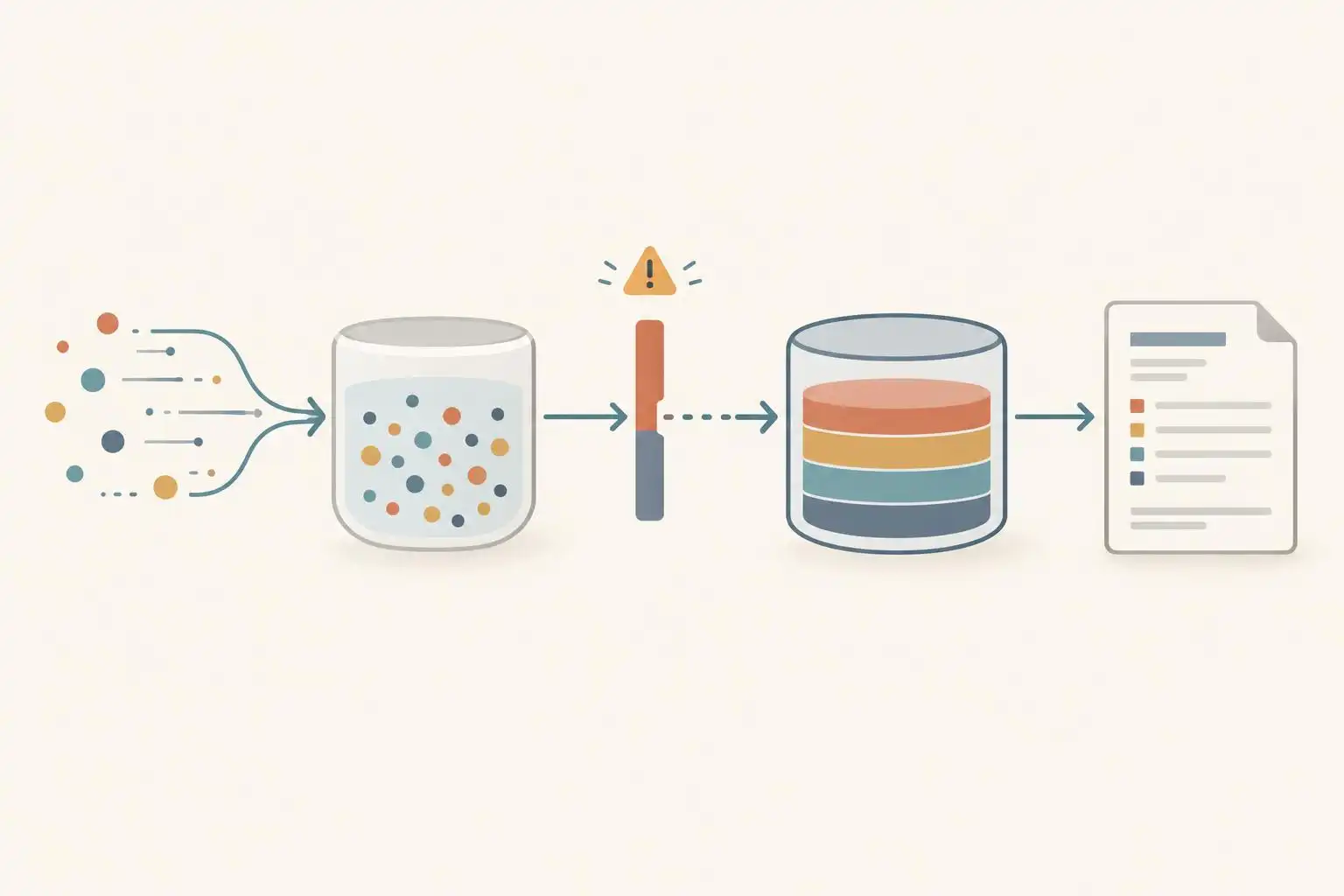
That is why I want to see a shadow invoice before I approve a pricing change. Take real historical usage, run it through the proposed terms without charging anyone, and compare the result with both the existing bill and the customer’s expectations. The exercise tests something a pricing-page mockup cannot: whether the business can actually deliver the offer it intends to sell.
The pricing model is not the invoice
Two plans can sound identical in a sales conversation and produce very different charges. “Rates fall as you grow” might mean graduated pricing, where only usage in each band gets that band’s rate. Or it might mean volume pricing, where total usage determines a rate applied according to the contract’s rules. Lago’s billing guide recommends testing the amounts immediately below and above each volume boundary because crossing one can even reduce the total bill.[2]
Credits and commitments add another layer. Does the included allowance reset monthly? Do prepaid credits cover overages but not the platform fee? Does unused credit roll forward? These are commercial decisions, not implementation trivia. A customer who hears “$500 a month, including one million calls” will reasonably assume the invoice follows the same arithmetic the salesperson used.
The shadow invoice turns those assumptions into a test. It should show the old charge, the proposed charge, the usage and rates that produced each, and a plain-language explanation of the difference. If your team cannot explain one customer’s increase without opening three dashboards, your customers will struggle more.
Sample accounts, not just sample calculations
A clean worked example proves that a formula works. It does not prove that your pricing works across your customer base. Before launch, I would replay at least three recent billing periods for a small set of accounts:
- A low-usage customer near the included allowance.
- A growing customer that crosses a rate boundary.
- A high-usage customer with uneven monthly consumption.
- An enterprise account with negotiated rates, credits, or a minimum commitment.
Add any segment whose usage creates unusual service costs. Fivetran’s strategic-finance job description explicitly connects account-level cost-to-serve analysis with the unit economics behind packaging changes.[4] That is the right instinct: a shadow invoice should tell you not only what the customer would pay, but whether the account would still be attractive to serve.
Look at the distribution, not just the average revenue lift. A 12% aggregate increase may hide a 70% jump for a small group of customers who use a feature exactly as you encouraged them to. Those accounts deserve investigation before launch, even if the model is mathematically correct.
Put the contract through the billing system
Do not stop at a spreadsheet. Feed the proposed plan into a test environment and ask the billing system to rate historical events. Then trace one account from usage event to customer-visible balance to invoice line item. Where does the allowance get deducted? Which rate applies to a negotiated customer? What happens when a credit runs out midway through the period?
This is also a practical way to evaluate billing tools. In its comparison of Lago and Chargebee, Lago suggests asking vendors to add a model, change a rate, and show where the calculation lives; it also notes that credit workflows differ between platforms.[6] Treat that as a test to perform, not a reason to take any vendor’s preferred conclusion on trust.
If the rated invoice differs from the spreadsheet, resist the temptation to label it an engineering bug and move on. The discrepancy might reveal a contract your proposed plan cannot represent or an exception Sales has been granting informally. Both are pricing findings.
Test what the customer sees before the bill arrives
The invoice is the final reveal, but it should not be the first one. In SaaStr’s account of Stripe’s AI pricing advice, customers are urged to see their consumption before a surprise bill arrives.[3] A shadow invoice lets you test that experience alongside the charge itself.
For each sample account, ask whether the product’s usage display would have helped an admin predict the new bill. If the meter shows tokens but the contract sells credits, show the conversion. If a balance excludes pending events, say so. An alert that arrives after a costly batch job finishes is technically accurate but commercially useless.
I would give Customer Success the draft invoice and ask them to explain it without a pricing specialist in the room. I would give Sales the same exercise for a prospect evaluating the new plan. Confusion in either conversation is evidence that the offer needs clearer terms, clearer product feedback, or both.
Make launch approval an operational decision
Pricing teams do not own every system that turns an offer into revenue. Asana’s pricing-strategy role describes implementation as a cross-functional effort involving Product, Sales, Customer Success, Finance, Operations, and Deal Desk—not merely a recommendation presented to executives.[5] A shadow-invoice review gives those teams one concrete artifact to approve.
Before launch, agree on which differences from the current bill are intended, which accounts need outreach, and which discrepancies block release. Save the approved examples as test cases. When someone changes a rate, credit rule, or allowance later, rerun them. The goal is not to prevent pricing changes; it is to make their effects visible before customers discover them for you.
A good new price should survive two tests: customers can understand why they pay it, and your systems can charge it consistently. The shadow invoice is where those tests meet.
References
- Usage-Based Billing: How It Works, Models & Examples (2026) — https://getlago.com/blog/usage-based-billing
- Stripe’s AI CRO on the Fastest-Growing AI Companies: 175% Growth, 48% of Revenue From Outside the Home Market, and Agents About to Read More Stripe Docs Than Human | SaaStrAI — https://www.saastr.com/stripes-ai-cro-on-the-fastest-growing-ai-companies-175-growth-48-of-revenue-from-outside-the-home-market-and-agents-about-to-read-more-stripe-docs-than-human
- Senior Strategic Finance Analyst at Fivetran | Andreessen Horowitz — https://jobs.a16z.com/jobs/fivetran/8036189003–senior-strategic-finance-analyst
- Pricing Strategy Director at Asana | Andreessen Horowitz — https://jobs.a16z.com/jobs/asana/8214906–pricing-strategy-director
- Lago vs Chargebee for SaaS and AI Usage Billing — https://getlago.com/blog/lago-vs-chargebee



Leave a Reply
You must be logged in to post a comment.