


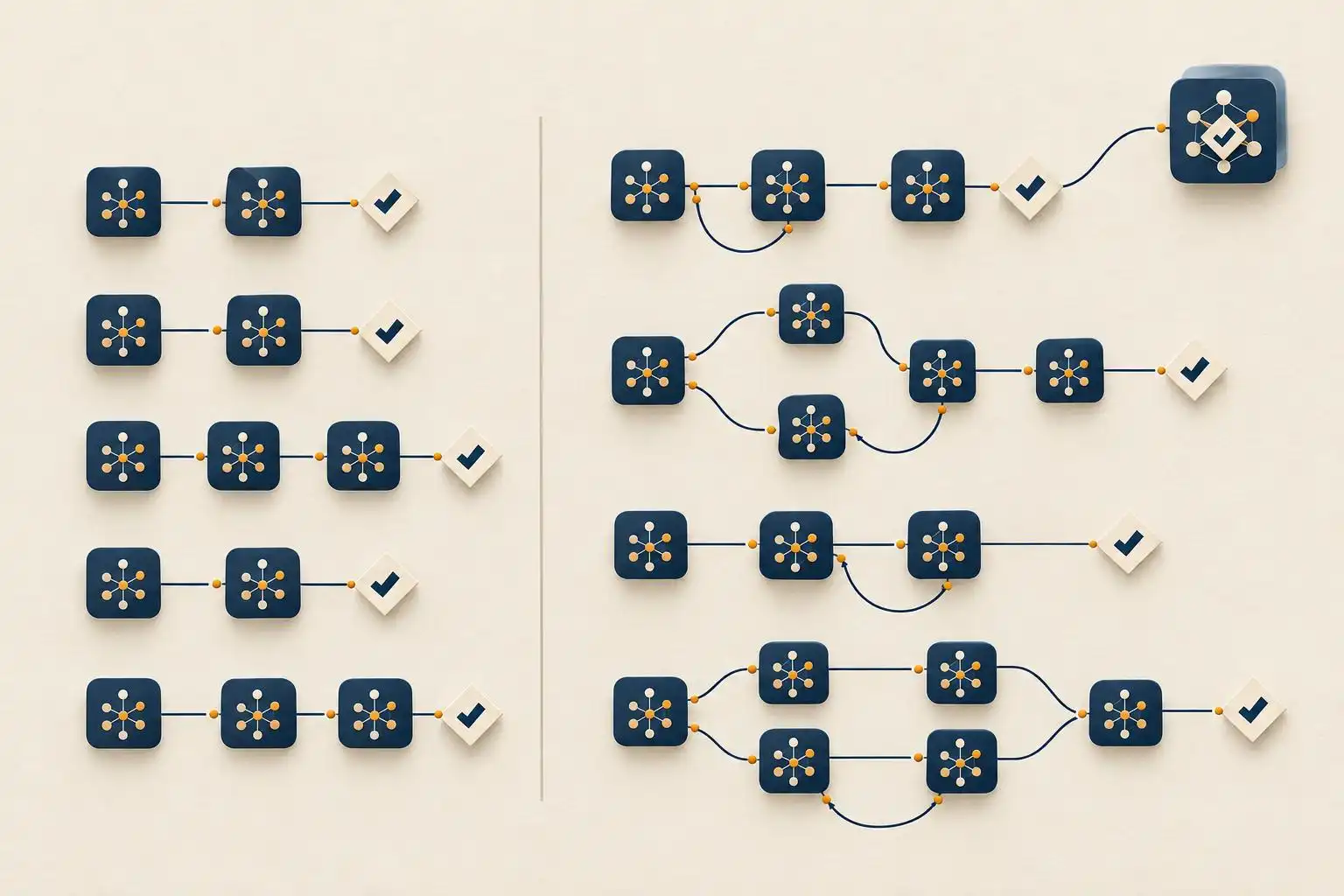
A customer asks your agent to reconcile an invoice. It finds a missing purchase order, searches a second system, tries a different model, and finally sends the case to a human. The customer sees one completed reconciliation. You see four attempts and an escalation.
That gap is becoming a pricing problem. A March 2026 Gartner estimate, reported in a sponsored TechCrunch article, puts agentic token consumption at five to 30 times that of a standard chatbot exchange per task.[1] The range is broad, but the point is practical: a task can have a variable cost before you know whether it will succeed. If you charge for completed work, you need to decide who pays for the attempts that precede it.
The average task is hiding the expensive ones
Founders often calculate cost per task by dividing an inference bill by completed tasks. That number is useful for reporting and dangerous for pricing. It blends clean runs with cases that require repeated tool calls, longer context, model escalation, human review, or another attempt after a failed check.
Consider an illustrative month with 10,000 completed tasks. Suppose the base run costs $0.60 per task, 8% incur an additional $2.50 in retries, and 2% incur an additional $12 in escalation costs. Variable cost is $10,400, or $1.04 per completion. At $2 per completion, gross margin is 48% before other variable costs.
Now imagine a customer whose cases are harder: 30% incur those retries and 10% require escalation. At the same rates, variable cost reaches $2.55 per task. The customer still buys a “completed task” for $2. The product is doing exactly what was promised, yet every additional completion worsens the economics.
A retry is a product decision
Not all additional work is waste. A second pass may catch a wrong answer; a human handoff may prevent a costly mistake. But neither is free, and neither should be an invisible side effect of an agent being allowed to keep going.
This is where model-shopping by token price can mislead. In a Hacker News discussion, one commenter cited task benchmarks where models with similar token prices had very different costs to finish coding and general tasks. That is a commenter’s reading of benchmarks, not a universal ranking, but it captures the right purchasing question: what does a verified completion cost on your workload?[6]
Caching makes the answer still more workload-specific. A coding-agent user described sessions whose input-token costs changed substantially depending on whether cached context remained available. It is a useful account of one workflow, not a basis for setting your own rates; the lesson is to measure context reuse in production rather than assume a published per-token price describes your actual cost.[3]
If your agent retries, route-switches, or escalates, those choices belong in your product specification. Define when each action is allowed and what evidence justifies it. Otherwise your pricing model depends on behavior you have not bounded.
Sell a completion with a defined service boundary
“Pay only for success” sounds simple until buyer and vendor disagree about success. Did an invoice reconciliation succeed when the agent proposed a match, when a rule validated it, or when the buyer accepted it? A useful contract names the acceptance point and the work included before that point.
For a bounded workflow, the offer might be: a fixed price for each validated reconciliation, including ordinary retries and automated checks. Cases requiring human judgment move to a separately priced review queue, and cases missing required customer data are returned without a completion charge. Those distinctions protect the buyer from paying for abandoned attempts while protecting the vendor from absorbing unlimited exceptional work.
The boundary must be visible in the product. Buyers should be able to see why a case was returned, escalated, or marked complete. If the agent merely stops after one failed attempt to preserve margin, the vendor has not built an efficient outcome-priced service. It has changed the meaning of the outcome.
Put a cost budget behind the promise
For each workflow, track cost and quality by customer and case type—not just by model or monthly account. At minimum, the operating view should show:
- Cost per validated completion, including failed attempts allocated to that workflow.
- Retry and escalation rates, alongside the reasons they occurred.
- Acceptance, correction, and reversal rates after a task is marked complete.
- The share of cases returned because required inputs were missing.
Then set a budget for how the agent pursues a completion. A cheaper model can take the first pass; a stronger model can handle a failed validation; a human can take cases that exceed a defined risk threshold. Those are design choices, not a universal routing recipe. The limit should reflect the value and risk of the task, and you should test whether it increases errors or shifts work back to the customer.
Inference providers are treating cost-per-token economics, reliability, SLAs, pricing, and gross margin as connected product concerns: Mistral’s cloud and inference product leadership posting explicitly groups them together.[4] An application founder has the same responsibility one layer up. The question is not only what a token costs, but how much work the service is willing to do to earn its fee.
Let hard cases change the offer
If one customer’s cases routinely cost more, do not quietly degrade their results to preserve the headline price. Find out why. Missing data may call for an onboarding requirement; unusually complex cases may need a review tier; a buyer demanding tighter turnaround may need a higher-priced service level. Sometimes the right answer is to decline a category of work the product cannot complete reliably at a viable price.
Outcome pricing works when the vendor owns the path to the result. That ownership includes the retries. Price a clearly defined completion, budget the attempts you will make to deliver it, and show the buyer where ordinary service ends. The margin is not in pretending every task takes one try. It is in knowing what you will do when it doesn’t.
References
- The hidden decisions behind every AI request | TechCrunch — https://techcrunch.com/sponsor/goodvision-ai/the-hidden-decisions-behind-every-ai-request
- JetBrains reports revenue growth, net financial loss for 2025 | Hacker News — https://news.ycombinator.com/item?id=49977072
- VP Product, Cloud & Inference at Mistral | Andreessen Horowitz — https://jobs.a16z.com/jobs/mistral-ai/c55aa346-38ea-46b5-8b39-1ce40e56dfe1–vp-product-cloud-inference
- Gemini 4 Argon | Hacker News — https://news.ycombinator.com/item?id=50073879


Leave a Reply
You must be logged in to post a comment.