
Every founder building an AI-native product eventually lands in the same place. They start with a clean pricing thesis — pure usage, or pure outcomes, or a flat subscription — and then reality hits. A big enterprise prospect demands predictability. A self-serve customer churns because their bill spiked. A competitor bundles AI into their base tier for free. And so, almost inevitably, the founder reaches for the hybrid model.
Hybrid pricing is the gravitational center of AI monetization right now. Most real businesses land there: a base subscription, plus usage, plus the occasional outcome or overage.[2] It sounds like the best of all worlds — predictability for the buyer, upside for the seller, flexibility for everyone. But hybrid pricing is also where most billing systems start to break,[2] and more importantly, where most pricing strategies quietly collapse under their own contradictions.
This isn’t an argument against hybrid pricing. It’s an argument for doing it on purpose, with your eyes open, instead of stumbling into it as a compromise that satisfies no one.
Why Pure Models Keep Failing
Let’s be honest about why founders reach for hybrid in the first place. Each pure model has a structural wound that bleeds out under pressure.
Pure usage-based pricing feels fair to customers, but it makes their bills hard to predict and yours hard to forecast.[2] The moment a customer’s AI workload spikes — because an agent ran longer than expected, because a new workflow got adopted, because a model upgrade consumed more tokens per task — you’ve handed them a surprise invoice. Surprise invoices generate churn, not loyalty. And on your side, usage revenue without a committed base is a forecasting nightmare. You can’t hire or invest against a number you can’t see coming.
Pure outcome-based pricing is the intellectually honest answer for agentic software that actually does things. You charge for a resolved support ticket, a completed task, a closed sales sequence. Customers love paying for value.[2] The problem is that you have to measure that value cleanly and make sure the price still covers your cost to serve.[2] Attribution is almost always messier than it looks in the pitch deck. What happens when the agent completes a task the human would have done anyway? What happens when the outcome is partially good? And critically: outcome-based pricing only works when the result is measurable and defensible.[1] Many of the most valuable things AI agents do are neither.
Pure subscription pricing is the SaaS instinct, and it’s the wrong instinct for inference-heavy products. Traditional SaaS was built around access — seats, plans, feature tiers, storage, add-ons, annual contracts.[1] It could afford to price access and manage cost later because the cost of goods was essentially fixed once the software was built. AI products don’t have that luxury. Every inference call comes with a cost.[3] A flat subscription that doesn’t account for usage variability is a margin time bomb.
The Hybrid Trap Is a Design Problem, Not a Pricing Problem
Here’s where most founders go wrong: they treat hybrid pricing as a packaging decision rather than an architectural one.
They slap a platform fee on top of usage billing, ship it, and call it hybrid. But they haven’t actually thought through which part of the business each layer is supposed to serve. The result is a model that confuses buyers (what am I paying the base fee for?), confuses the sales team (how do I quote this?), and confuses finance (how do I model expansion revenue?).
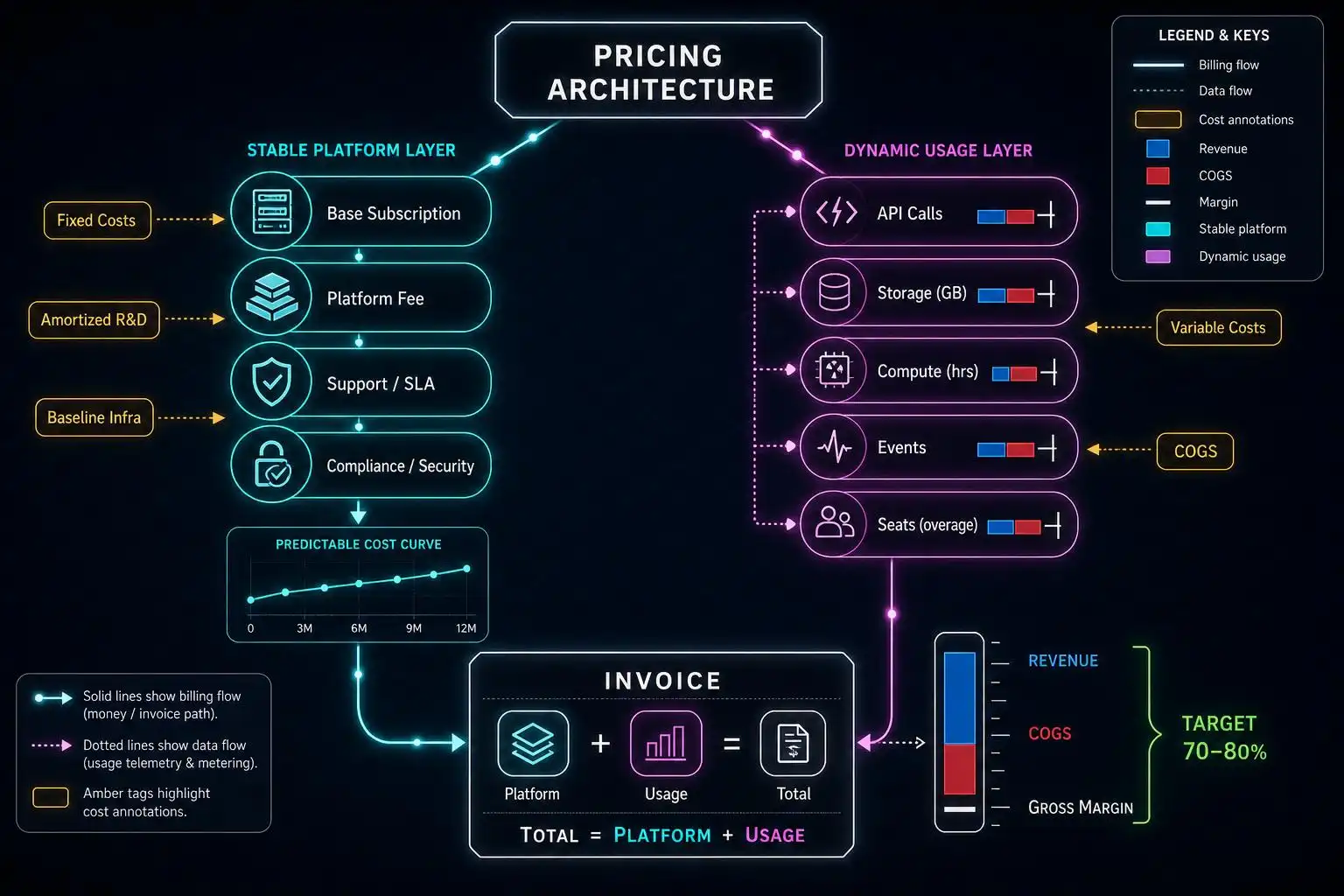
The right way to think about hybrid pricing is as two separate businesses that happen to share a customer.[3] The platform layer is a SaaS business. It earns the base fee by delivering access, collaboration features, integrations, security controls — the things that have fixed or near-fixed costs and scale cleanly. The usage layer is an inference business. It earns variable revenue by doing computational work, and its economics are governed by token costs, model selection, and workload efficiency.
These two layers have different financial dynamics, different gross margin profiles, and different expansion motions. Track them individually first, then bring them together.[3] If you blend them from day one, you’ll never know which part of your business is healthy and which is quietly bleeding.
The Metrics Problem Nobody Talks About
Hybrid pricing doesn’t just complicate billing — it complicates measurement. And measurement is where AI-native companies are already behind.
Switching from seat-based pricing to token-based pricing changes the game entirely. Traditional SaaS metrics like ARR and Magic Number become less relevant as primary health indicators.[3] In a hybrid model, you need to track the platform layer with SaaS metrics and the usage layer with consumption metrics — and you need to be disciplined enough not to let one layer’s numbers paper over the other’s problems.
The specific metrics that matter for the usage layer: token consumption per customer (which replaces MAU/DAU as your engagement signal), contribution margin per 1,000 tokens at the workload level (which tells you whether high-usage customers are actually profitable), and first-year value as a proxy for short-term customer profitability.[3]
That last one matters more than founders expect. In a hybrid model, the base fee creates a revenue floor, but the usage layer is where expansion happens. If your high-usage customers are consuming tokens at a rate that erodes contribution margin, you don’t have an expansion business — you have a cost problem wearing a growth costume.
The Margin Math You Can’t Ignore
The right pricing model depends on cost, value, buyer trust, operational complexity, and margin risk.[1] That’s not a cop-out — it’s a framework. And the most underweighted variable in that list is cost.
No matter which model you choose, you need to know your AI and cloud infrastructure costs down to the penny.[4] Every API call, inference, and database query adds up. Without clear visibility into compute, storage, and API costs, any pricing strategy is guesswork.[4]
This is especially true in a hybrid model because the base fee creates a psychological anchor for both the buyer and the seller. Buyers feel like they’ve already paid for the product. Sellers feel like usage revenue is pure upside. Neither framing is accurate. The base fee needs to cover platform costs with healthy margin. The usage fee needs to cover inference costs with healthy margin. They don’t subsidize each other — or if they do, that’s a deliberate cross-subsidy you should be able to name and defend.
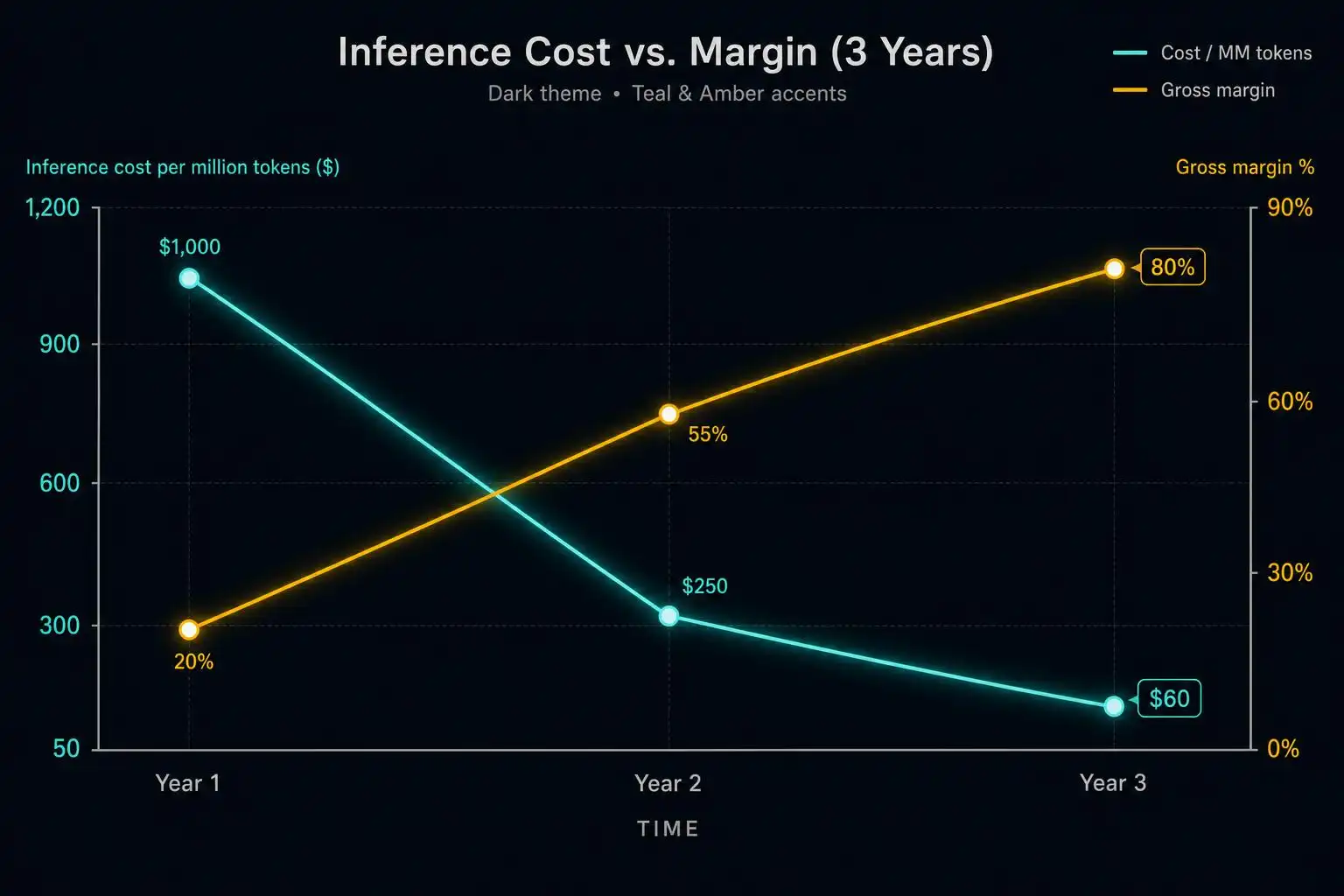
The good news on inference costs is real: GPT-4-equivalent models now cost around $0.40 per million tokens, down from $20 just three years ago.[3] That deflationary trend gives you room to maneuver. But it also means your pricing assumptions have a shelf life. Reassess your cost basis and your pricing calibration at least annually — and build the operational infrastructure to update pricing rules without rebuilding your billing platform.[2]
The Operational Reality of Hybrid
Here’s the thing nobody in the pricing conversation says loudly enough: AI agent pricing models are not just pricing-page decisions. They need to flow through quote, contract, usage, rating, invoice, cost, margin, and revenue reporting.[1]
A hybrid model that looks clean on a pricing page can become a billing nightmare at scale. You’re rating two different types of events — fixed subscription periods and variable usage events — against two different cost structures, and rolling them into a single invoice that a customer needs to understand and approve. That’s a non-trivial engineering and operational investment.
Founders who haven’t done this before tend to underestimate the cost of the billing infrastructure required to support hybrid pricing correctly. The wrong pricing model doesn’t only affect packaging. It affects how the business sells, bills, measures, and protects every unit of agent work.[1]
When Hybrid Is the Right Answer (and When It Isn’t)
Hybrid pricing works when you genuinely have two distinct value propositions — platform access and computational work — that map to two distinct buyer willingness-to-pay curves. It works when your sales motion can explain both layers clearly and quote them with margin-aware intelligence. It works when your billing infrastructure can handle metered events alongside subscription periods without breaking.
It doesn’t work when it’s a hedge. It doesn’t work when the base fee is set arbitrarily and the usage pricing is set by copying a competitor. It doesn’t work when you haven’t instrumented your product well enough to know what a token of work actually costs you at the workload level.
The question isn’t whether hybrid pricing is good or bad. The question is whether you’ve built a hybrid pricing model or just bolted two pricing models together and hoped for the best.
There’s a version of hybrid that captures more value than any pure model, aligns price with the actual cost structure of AI-native software, and gives buyers the predictability they need to commit. That version requires treating pricing as an architectural decision, not a packaging afterthought.
The founders who get this right will build businesses with durable margins and defensible expansion revenue. The ones who get it wrong will spend the next two years wondering why their best customers are also their least profitable ones.
References
- AI Agent Pricing Models Compared: Usage, Outcome & Hybrid — Revinci — https://www.revinci.ai/blogs/ai-agent-pricing-models-compared
- Effective Strategies for Monetizing Your AI — LogiSense — https://logisense.com/ai-monetization
- How Your AI Monetization Model Should Impact The Metrics You’re Measuring — Data-Mania, LLC — https://www.data-mania.com/blog/how-ai-monetization-model-should-impact-metrics
- How SaaS Companies Can Profitably Price AI Agents — CloudZero — https://www.cloudzero.com/blog/ai-agent-pricing-models



Leave a Reply