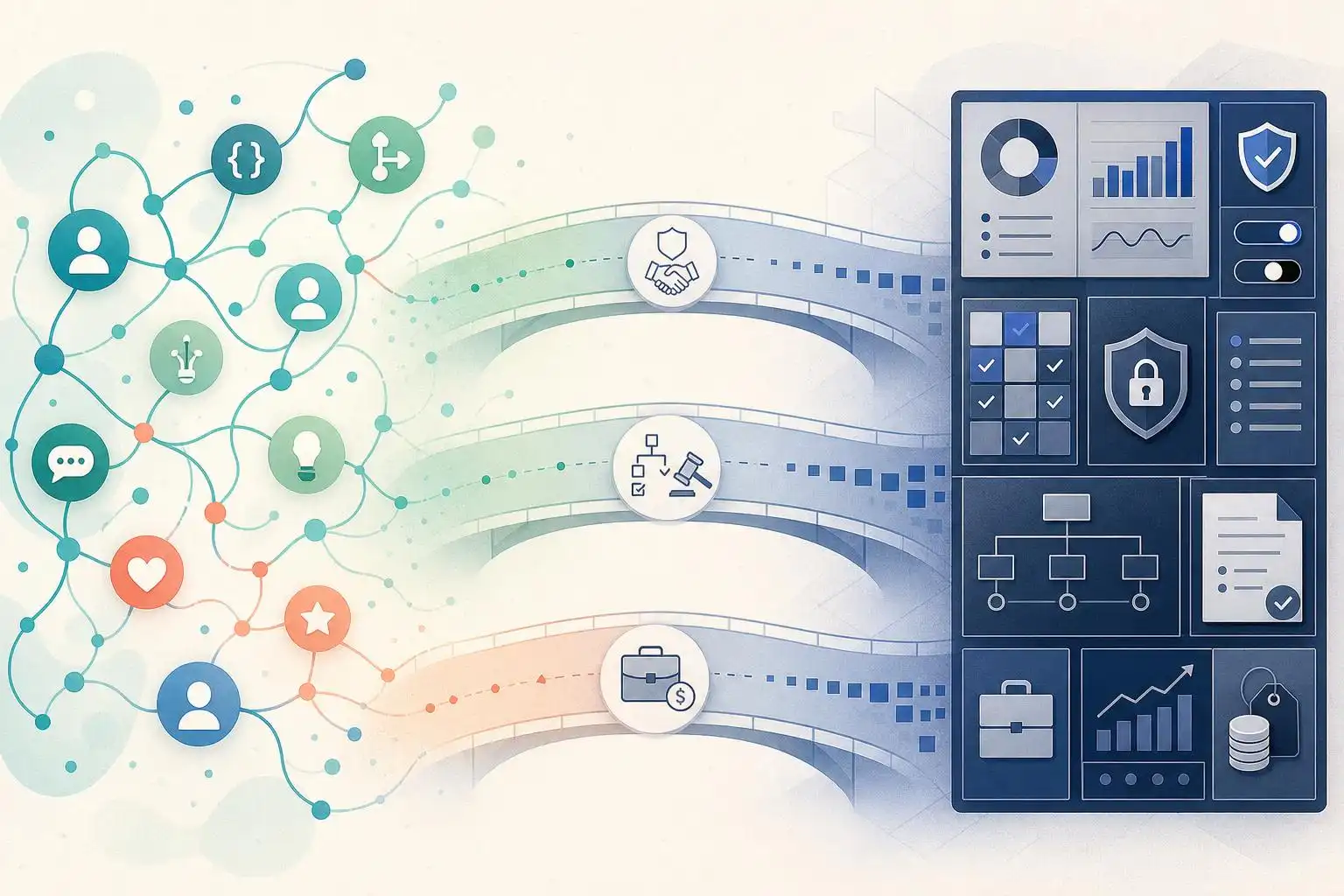

One of the easiest ways to make an open source business feel rational on a spreadsheet is to pretend every GitHub star, Docker pull, Discord member, and free installation is an early-stage sales opportunity.
It is also one of the fastest ways to corrupt the product, annoy the community, and disappoint the board.
Free users are not “unmonetized customers.” Most of them are not customers at all. They are learners, evaluators, hobbyists, internal champions, future employees, plugin authors, bug reporters, and sometimes just people solving a problem on a Sunday night. A few will become buyers. Many will never pay you a dollar, and still make the project more valuable.
The discipline of an open source business is not to convert everyone. It is to know which usage contains commercial intent, and to build a path from that intent to a paid product without making the free product feel like a trap.
The mistake: treating adoption as pipeline
Open source adoption is wonderfully visible compared with most software distribution. You can see stars, forks, issues, package downloads, community posts, and inbound questions. That visibility creates a dangerous illusion: because you can count activity, you assume you can forecast revenue from it.
But community activity and purchasing intent are different signals.
A developer using your library in a weekend side project may be deeply engaged and entirely non-commercial. A quiet infrastructure director who never comments on GitHub may be weeks away from buying because three internal teams now depend on your project. The noisy signal is not always the valuable one.
This is why “we have 50,000 users, so we only need to convert 1%” is usually not a strategy. It is a hope with arithmetic attached.
A better question is: Which moments in the user journey reveal that the problem has moved from individual productivity to organizational risk?
That is where open source companies earn the right to charge.
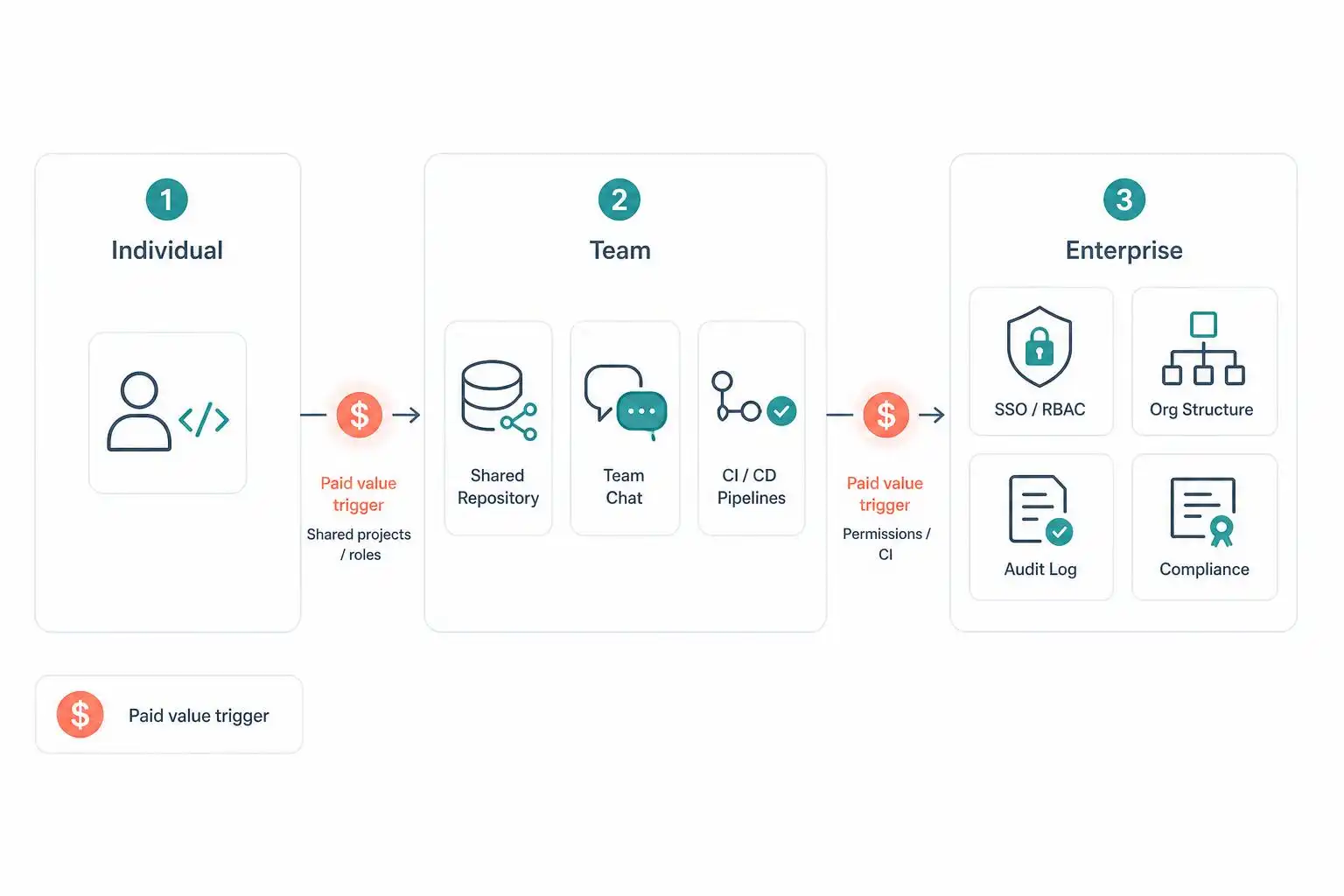
Commercial intent starts when the problem changes owner
Most free software adoption begins with an individual. Someone has a job to do, your project helps, and the transaction is simple: they invest time, you provide capability.
Revenue becomes plausible when the problem is no longer owned by that individual alone.
That shift can show up in several ways:
- Multiple teams depend on the same instance. The software is no longer a tool; it is shared infrastructure.
- Someone needs accountability. Uptime, response time, security posture, or roadmap visibility now matters.
- Governance enters the conversation. Permissions, audit logs, SSO, policy controls, and compliance are required.
- The cost of self-management becomes visible. Upgrades, backups, scaling, and incident response are no longer “free” because engineering time is not free.
- Executives ask what it is and who owns it. This is often the moment an internal tool becomes a vendor relationship.
Notice what is absent from that list: love for the project. Love helps. It creates trust and preference. But love does not create budget by itself. Budget appears when an organization has something to protect, accelerate, standardize, or de-risk.
Package the organizational problem, not the community’s enthusiasm
The open-core line should not be drawn around annoyance. If your paid product is primarily a collection of things you withheld to make the free product frustrating, users will feel it. They may still pay, but they will not advocate.
A healthier line separates individual capability from organizational capability.
The open source project should be genuinely useful. It should let someone understand the technology, solve real problems, run it in production if they have the skill, and trust that the project exists for reasons beyond lead generation.
The paid product should answer the questions organizations ask once usage becomes important:
- Who can access what?
- Can we prove what happened?
- Can we integrate this with our identity, security, and deployment systems?
- Can we recover quickly if something fails?
- Can we standardize usage across teams?
- Can we get help from people who know the system deeply?
This is why enterprise features are not merely “checkboxes for big companies.” Done well, they are the productization of organizational trust.
SSO is not valuable because login screens are exciting. It is valuable because a company cannot have ex-employees retaining access to critical systems. Audit logs are not valuable because anyone enjoys reading them. They are valuable because, during an incident, ambiguity is expensive. Role-based access control is not valuable because administrators like complexity. It is valuable because shared infrastructure without boundaries eventually becomes a security problem.
When you frame paid features this way, pricing feels less like a toll booth and more like a transfer of responsibility.
Do not make sales own the whole bridge
Many open source companies underinvest in the product bridge between free use and paid adoption. They rely on sales to discover who is using the project, explain the commercial product, justify the value, and navigate procurement.
Sales can help, especially in larger accounts. But if the only path from free to paid requires talking to a human, you will miss a large portion of commercial intent.
The product itself should help users recognize when they have crossed into organizational territory.
That does not mean littering the interface with upgrade nags. It means designing honest moments of education:
- When a user invites the fifth teammate, explain team management options.
- When an admin configures production settings, show backup and high-availability capabilities.
- When usage expands across environments, explain governance and observability features.
- When a security-relevant action occurs, show where audit controls live.
The best upgrade prompts feel like timely advice. The worst feel like punishment for success.
A useful test: would the message still be helpful if the user did not buy today? If yes, you are probably educating. If no, you are probably nagging.
Be careful with telemetry and identification
Open source companies often want better visibility into who is using the project. This is understandable. It is hard to build a business when your most important adoption happens behind firewalls you cannot see.
But the way you gather signals matters enormously.
Secretive telemetry is a trust tax. Even if the data is benign, users do not like discovering that a tool they installed has been phoning home in ways they did not understand. The short-term benefit of account identification is not worth the long-term suspicion it creates.
If you collect usage data, be explicit. Make it documented, minimal, configurable, and easy to disable. Explain what you collect and why. Better yet, give value back: diagnostics, upgrade readiness, health checks, benchmarking, or security alerts.
There are also many commercial signals that do not require invasive tracking:
- Inbound requests about security reviews, procurement, or compliance.
- Questions about multi-team deployment patterns.
- Repeated visits to pricing, hosting, or enterprise documentation.
- Community questions that mention production scale or internal rollout.
- Marketplace, cloud, or managed-service trials tied to company domains.
Open source trust is compounding capital. Do not spend it casually.
The free user still matters, even when they never pay
A purely transactional view of open source misses why the model works.
Free users improve the software through bug reports, edge cases, integrations, documentation fixes, tutorials, and credibility. They make the project easier to adopt inside companies because employees have already encountered it elsewhere. They create the labor market around your product. They reduce perceived vendor risk because the technology has a life beyond your company.
Some of the most valuable community members will never be buyers. Treating them as failed conversions is both inaccurate and ungrateful.
The right mental model is not a funnel where every free user is supposed to move downward. It is an ecosystem with different forms of contribution and value exchange. Revenue is one form. Distribution, feedback, legitimacy, and talent are others.
This does not mean you should be shy about charging. It means you should charge the people and organizations receiving commercial value, not extract friction from everyone else.
Build your conversion model around triggers
If I were advising an open source founder on monetization, I would not start with “What percentage of users can we convert?” I would start with a trigger map.
List the events that suggest a user’s problem has become organizational:
- They are deploying in production.
- They are adding teammates or teams.
- They need centralized administration.
- They are subject to security or compliance review.
- They are scaling beyond what self-managed operations can comfortably support.
- They need guaranteed help, not best-effort community support.
Then map each trigger to a paid capability, a message, and a path.
For example:
- Trigger: Multiple teams using the same deployment. Paid value: team management, RBAC, admin controls. Path: in-product education and a team plan.
- Trigger: Security review. Paid value: SSO, audit logs, compliance artifacts. Path: security documentation, procurement-ready package, enterprise contact.
- Trigger: Operational burden. Paid value: managed cloud, backups, upgrades, SLA. Path: migration guide and cost-of-ownership comparison.
This exercise forces clarity. It prevents you from monetizing random surface area and helps your team understand why a feature belongs in paid packaging.
Conversion is a consequence of trust
Open source buyers often arrive with more information and more skepticism than conventional SaaS buyers. They have seen the code. They have read the issues. They may know the maintainers by name. They may also have watched other companies change licenses, neglect communities, or squeeze users after adoption.
That history sits in the room during every commercial conversation.
The companies that do best are usually not the ones with the most aggressive conversion mechanics. They are the ones that make the paid path feel like a natural continuation of the free relationship: more accountability, more convenience, more governance, more scale.
Do not ask, “How do we monetize our free users?”
Ask, “When does our software become important enough that an organization needs a commercial relationship around it?”
That question leads to better packaging, better timing, better sales conversations, and a healthier community. It also keeps you honest. Because the goal is not to make free users pay. The goal is to make the people receiving paid value understand why paying is the obvious, responsible choice.

Leave a Reply