
A pure subscription is comforting until your best customers start using the product 40 times more than everyone else. Pure pay-as-you-go is elegant until your CFO asks why next quarter’s revenue forecast looks like a weather report.
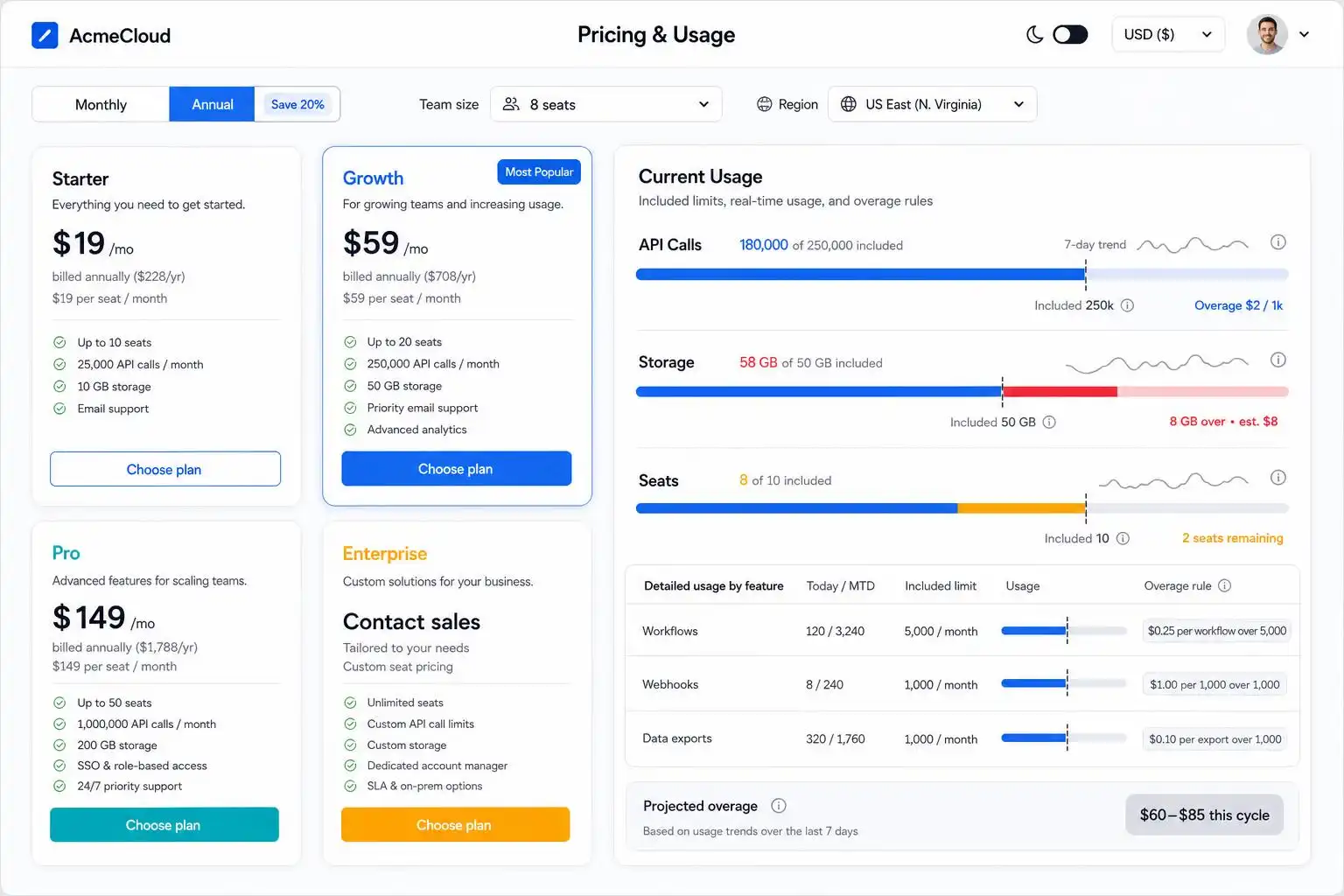
That is why the market keeps drifting toward hybrid pricing: a predictable subscription floor, a usage meter for expansion, and a clear promise about what the customer is actually buying. Paddle’s recent pricing research makes the same point: the strongest SaaS companies increasingly combine base subscriptions with usage-based components, especially as AI changes both product costs and customer value curves.[1] Lago’s usage-based pricing research is even more explicit: the 61% of SaaS companies exploring consumption-based models are mostly moving toward hybrid, not pure pay-per-use, because pure consumption is difficult for both vendors and buyers to forecast.[3]
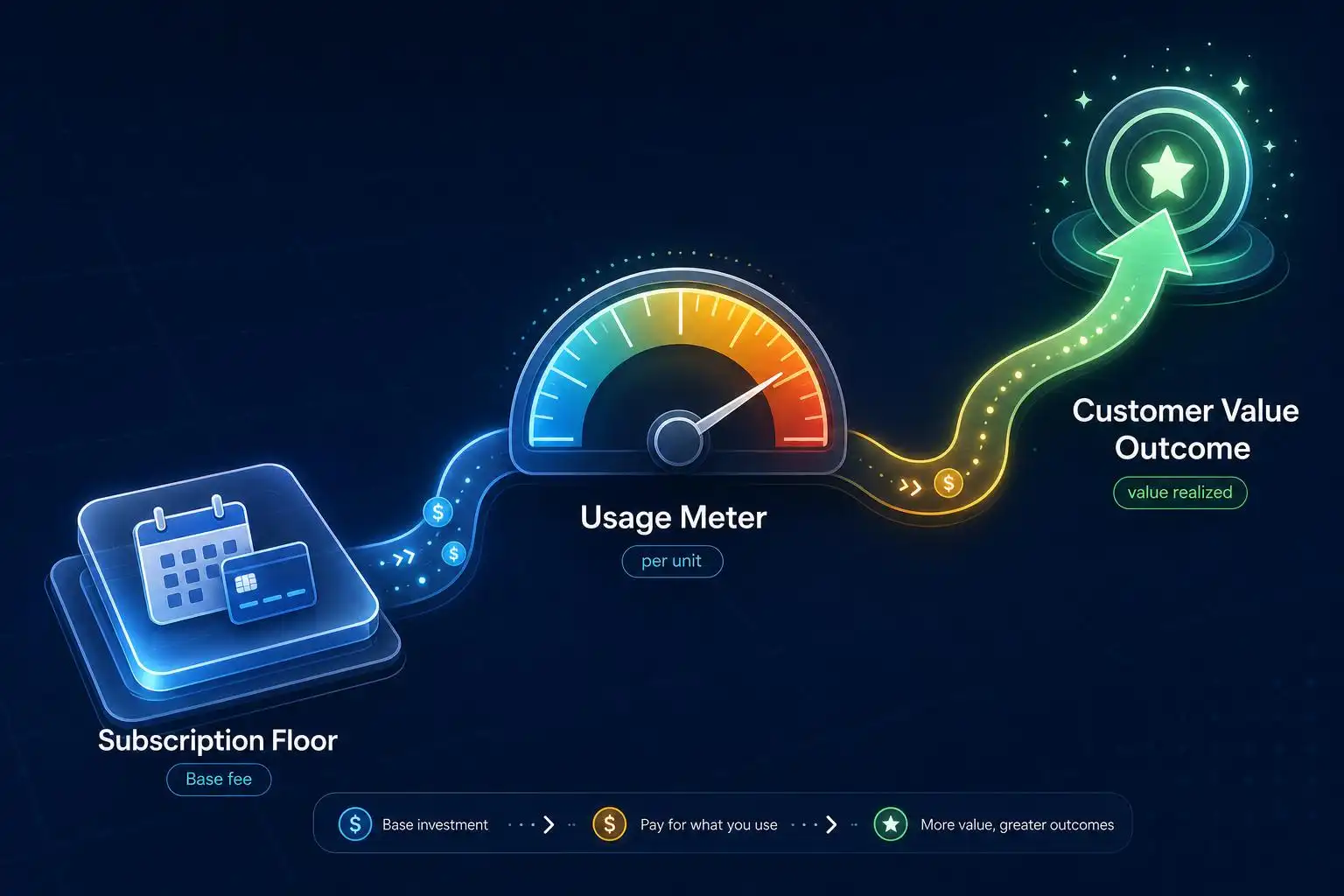
I agree with the direction. But I worry many founders are copying the mechanics of hybrid pricing without understanding the psychology. A hybrid model is not “subscription plus random overages.” It is a contract between you and the customer about risk, fairness, and upside.
If you get that contract right, pricing becomes easier to explain and easier to expand. If you get it wrong, you create surprise invoices, procurement friction, and a customer success team that spends its life apologizing for the pricing page.
The floor is not just revenue protection
Most teams describe the base subscription as a way to create predictable recurring revenue. That is true, but incomplete.
The subscription floor also tells the customer what kind of product they are buying. It packages identity.
A $29/month product says: “This is a self-serve tool.” A $2,000/month platform fee says: “This is operational infrastructure.” A $50,000 annual minimum says: “We expect executive scrutiny, implementation, and measurable ROI.”
That matters because customers do not evaluate price only against usage. They evaluate it against category expectations. B2B buyers are usually willing to tolerate more packaging complexity when the product maps to business value, implementation help, security, support, or measurable efficiency gains.[1] The mistake is treating the subscription floor as an accounting device instead of a positioning device.
A good floor does three jobs:
- It covers your fixed service burden. Support, onboarding, compliance, account management, and product maintenance do not scale neatly with API calls or tokens.
- It creates commitment. Customers who pay a meaningful base fee are more likely to implement, train teams, and build habits.
- It frames the meter. Usage charges feel fairer when customers understand what is already included and why additional consumption costs more.
This is why I like “included usage” more than naked pay-as-you-go for most application-layer SaaS. Supabase is a clean example from infrastructure: its Pro tier includes defined database, storage, and bandwidth allowances, then charges overages beyond those limits, while the database keeps running instead of abruptly cutting customers off.[3] That last part is important. The product does not turn into a parking meter. It keeps delivering value, and the invoice reflects the extra consumption.
The meter has to match the customer’s value story
The most consequential pricing decision in a hybrid model is not the base price. It is the value metric.
A bad meter makes customers feel punished for succeeding. A good meter makes expansion feel inevitable.
The best value metrics have four properties:
| Test | Good sign | Warning sign |
|---|---|---|
| Value alignment | More usage generally means more customer value | More usage reflects inefficiency, retries, or vendor-side waste |
| Predictability | Customers can estimate expected volume | Customers discover usage only after the invoice arrives |
| Controllability | Customers can influence usage behavior | Customers feel usage is outside their control |
| Auditability | Both sides can verify the count | Billing depends on opaque internal logic |
This is where AI products need extra discipline. Tokens, GPU-seconds, conversations, resolutions, documents processed, agents deployed, tasks completed — each tells a different value story. Lago’s glossary frames the issue well: the right value metric aligns cost with value delivered, while a poor one creates gaming, friction, or misalignment.[6]
For AI infrastructure, tokens or compute units may be acceptable because the buyer understands the production input. For AI applications, those same metrics often feel alien. A customer service leader does not wake up wanting 80 million tokens. She wants fewer tickets, faster answers, and higher CSAT. That is why outcome-oriented models — such as charging per conversation or per resolution — are gaining attention as AI agents act autonomously on behalf of customers.[3]
But outcome pricing has a hard edge: you must define the outcome. “Resolution” sounds simple until a customer asks whether a reopened ticket counts, whether escalations count, whether refunds count, and whether a hallucinated answer counts. The closer your metric gets to business value, the more your billing logic needs product, data, legal, and customer success alignment.
The promise is what prevents surprise
Hybrid pricing fails when the customer cannot answer three questions:
- What do I get before usage charges begin?
- What behavior creates extra charges?
- How will I know before I cross an uncomfortable threshold?
This is the difference between a useful meter and a hidden tax.
A founder once showed me a pricing page with the line: “Includes generous AI credits.” I asked what “generous” meant. She said, “We don’t want to overwhelm users with details.” That is not simplicity. That is deferred confusion.
Customers do not need every billing formula on the pricing page, but they do need enough specificity to trust you. “Includes 1,000 completed analyses per month, then $0.08 per additional analysis” is far better than “AI credits included.” Even if the underlying system uses tokens, credits, and model-routing rules, the buyer-facing metric should be understandable.
Lago’s tactical guidance notes that hybrid pricing commonly uses a subscription covering a usage allowance, then charges per unit above that threshold; this balances predictable revenue with customer flexibility.[5] The phrase I would underline is “above that threshold.” The threshold must be visible. Invisible thresholds are where trust goes to die.
Regional willingness to pay still matters
One under-discussed advantage of hybrid pricing is that it gives you more knobs to adapt by segment or market.
Paddle’s data shows substantial regional willingness-to-pay differences: Nordic customers pay 28% more than U.S. prices on average, while Brazilian customers pay 12% less.[1] You can respond to that with localized sticker prices, but hybrid pricing gives you more nuanced options:
- Keep the same plan names but localize base subscription prices.
- Adjust included usage allowances by region.
- Offer annual prepaid usage bundles in markets with procurement constraints.
- Use tax-inclusive pricing where buyer expectations demand it.
The caveat: do not create a pricing maze. Regional pricing should reduce purchasing friction, not create arbitrage games or internal quoting chaos. If your sales team needs a spreadsheet, three Slack threads, and a blessing from finance to quote Brazil differently from Denmark, your system is not mature enough for the segmentation you are attempting.
The billing system becomes part of the product
Founders love pricing strategy conversations and underestimate billing architecture conversations. In hybrid pricing, that separation is dangerous.
A pricing page can promise overages, credits, usage caps, volume discounts, prepaid commits, and enterprise exceptions. But the invoice has to make those promises true. Pay-as-you-go and hybrid models introduce operational complexity: metering accuracy, compliance, real-time previews, revenue recognition, dispute workflows, and plan-change logic.[7]
Progressive billing adds another layer. If charges adjust as usage grows — common for elastic SaaS and AI workloads — delayed or inaccurate metering can quickly become a customer dispute.[5] This is not just a finance problem. It is a product experience problem.
Before launching a hybrid model, ask:
- Can customers see current usage before invoice day?
- Can admins set alerts or caps?
- Can sales quote the same logic that billing executes?
- Can support explain an invoice in plain English?
- Can finance reconcile usage revenue without heroic manual work?
- Can product test packaging changes without waiting six weeks for engineering?
If the answer to most of these is no, simplify the model before you ship it.
A practical hybrid pricing blueprint
For most B2B SaaS and AI application companies, I would start with this structure:
1. Three to four value-based tiers
Use tiers to separate customer maturity, not merely to hide features. Each tier should answer: “Who is this for?” Paddle points out that tiered pricing works because it creates natural upgrade paths across segments, but too many tiers cause decision paralysis and confused buyers.[1]
2. A subscription floor in each tier
Price the floor around the customer’s expected value, support burden, and commitment level. Do not set it only by marginal cost.
3. Included usage that matches the tier promise
The entry tier should include enough usage to reach first value. The growth tier should include enough usage for habitual adoption. The enterprise tier should include room for scale, governance, and negotiation.
4. Transparent overages
Overages should be easy to calculate, easy to forecast, and easy to explain. If the raw cost driver is too technical, translate it into a buyer-facing unit.
5. Guardrails before monetization shocks
Usage alerts, admin dashboards, caps, soft limits, and pre-purchase bundles are not nice-to-haves. They are shock absorbers.
6. Enterprise commits where variability is high
For larger accounts, use annual minimums, prepaid credits, or volume commitments. Enterprise customers often expect custom support, SLAs, integrations, and negotiated terms, and pricing should account for that high-touch motion.[1]
The real test: would the customer call this fair?
Hybrid pricing is popular because it solves a real tension. Vendors want predictability. Customers want fairness. Usage meters let you participate in customer growth, while subscription floors keep the business investable.
But the model only works if customers understand the bargain.
A good hybrid model says: “Pay this much to access the platform and achieve a baseline outcome. If you get more value, your bill grows in a way you can see, control, and justify.”
A bad hybrid model says: “Here is a subscription. Also, surprise.”
The mechanics may look similar in a billing system. They feel completely different to a buyer.
References
- SaaS Pricing Models and Strategies | Paddle — https://www.paddle.com/blog/saas-pricing-models-strategies-fltr
- Lago Blog | 10 Usage-Based Pricing Examples: How Real SaaS Companies Charge for Value — https://www.getlago.com/blog/usage-based-pricing-examples
- 7 Usage-Based Pricing Tactics: What Snowflake, AWS, and Twilio Actually Do | Lago — https://www.getlago.com/blog/usage-based-pricing-tactics-for-saas-and-ai
- Pricing and Billing Glossary (2026) | Lago — https://getlago.com/blog/pricing-billing-glossary
- Understanding the Pay-as-You-Go Pricing Model for SaaS Businesses | Lago — https://getlago.com/blog/pay-as-you-go-pricing



Leave a Reply