

There’s a moment every AI-native founder eventually hits. You’ve shipped the product, customers are using it, and the billing model you stood up — credits, tokens, some kind of unit — feels clean and tidy on the surface. Then a customer asks a simple question: “What exactly am I paying for?” And you realize you can’t answer it in one honest sentence.
That’s not a communication problem. It’s a structural one. And it’s becoming the defining challenge of monetizing AI in 2026.
The Credit Layer Is a Cope
Credits were supposed to solve the problem of exposing raw token costs to customers. Nobody wants to explain context windows and model weights to a VP of Operations trying to justify a software renewal. So vendors abstracted everything behind a credit system: spend credits, get outcomes, don’t worry about the machinery underneath.
The trouble is that abstraction cuts both ways. When credits hide the true cost drivers — model choice, prompt size, agent loop depth, retry behavior — they also hide the spend trajectory. As Flexera’s analysts put it bluntly: credits make it difficult to answer essential questions, and “the result is spend that grows faster than governance.”[1]
For your customers, that’s a FinOps nightmare. For you, it’s a churn event waiting to happen. When AI spend surfaces at renewal as a surprise, you’ve already lost the trust battle.
Why Agents Break Everything You Thought You Knew
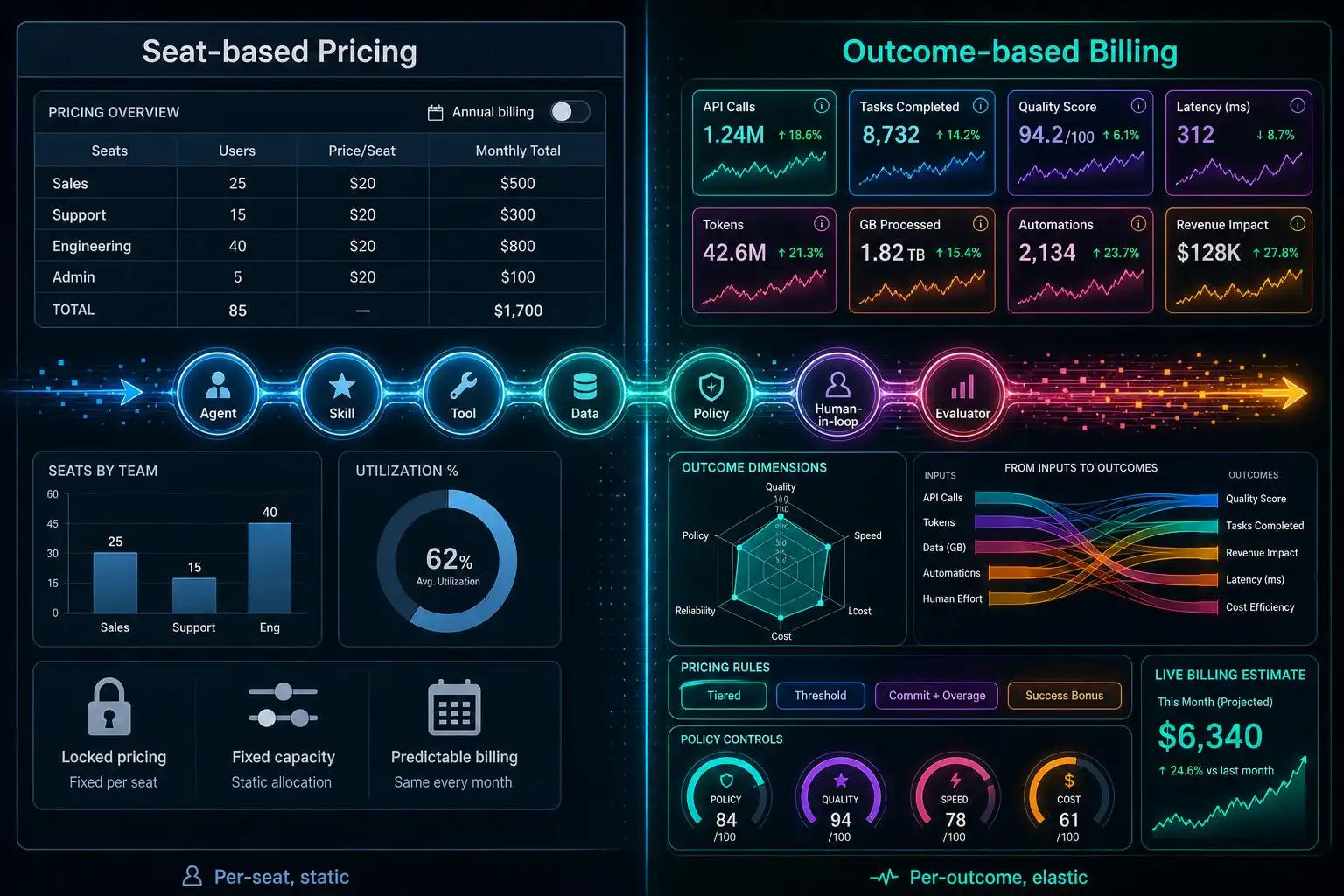
Seats broke because they priced access, not value. Credits break because they price consumption without anchoring to outcomes. But the real tectonic shift is agents — and agents introduce a third failure mode: volatile, non-linear spend that no flat metric can contain.
Agent loops, retries, and tool-calling amplify token usage in ways that are genuinely hard to predict.[1] Agentic workflows can consume significantly more tokens than simple prompt-response interactions, depending on how many tools are called, how many times a failed step is retried, and how deep the reasoning chain goes. When an agent manages an entire workflow without a human touching it, the “per seat” concept doesn’t just become irrelevant — it becomes actively misleading. The real unit of value becomes the task completed or the workflow executed.[4]
This is the core tension: your costs are driven by compute behavior, but your customers want to pay for business results. The gap between those two things is where margin goes to die.
The Hybrid Trap (And Why It’s Still Better Than the Alternative)
Most vendors land on a hybrid model — a base subscription that anchors the deal, with a usage or outcome layer on top to capture AI consumption.[1] This is the dominant transitional structure right now, and it’s not wrong. It gives customers a predictable floor and gives you a mechanism to expand revenue as usage grows.
But hybrid models carry their own failure mode: they let you delay the hard conversation about what you’re actually pricing.
The base subscription says: you’re paying for access. The usage layer says: you’re paying for consumption. Neither says: you’re paying for the outcome we delivered. Until you can make that third statement credibly, you’re running a hybrid model that’s really just a legacy seat contract with a credit meter bolted on.
The right data infrastructure is what makes the difference. As the billing practitioners at Orb have argued, you can’t bill for what you don’t track — and effective usage tracking needs to capture not just which endpoint was accessed and what resources were consumed, but what business outcome resulted.[2] A company that starts with API-call billing but wants to shift to outcome-based pricing later needs that dimensional data from day one, or the pivot requires a full reengineering effort.
What a Defensible Pricing Metric Actually Looks Like
Here’s the test I’d apply to any AI pricing metric: can your customer draw a clear line from what they pay to what they get?[3] If the answer requires them to understand your inference stack, you’ve failed. If the answer is “it depends on how the agent behaves this month,” you’ve also failed.
The pricing models worth building toward have a few properties in common:
They’re tied to value the customer actually feels. Workflow-based pricing — charging for the work performed rather than the compute consumed — is gaining traction fast as agents replace manual effort across sales, service, and operations.[1] A proposal generation vendor that charges per proposal isn’t hiding anything. Clay, a data enrichment platform, uses token- or credit-based pricing — a similar activity-based approach.[5]
They’re fair to both sides as costs move. Traditional SaaS had near-zero marginal cost per additional customer. AI doesn’t — every request uses real compute, which means a small number of heavy users can quietly eat your profit if your pricing doesn’t account for them.[3] A good metric expands with value delivered, not just with volume consumed.
They’re simple enough to explain in one sentence. This is harder than it sounds. The pressure to capture every dimension of AI cost leads to pricing structures that require a spreadsheet to decode. That complexity breeds resentment, and resentment breeds churn.
The Outcome Attribution Problem You Can’t Ignore
Here’s what nobody tells you when you start designing outcome-based pricing: attribution is the hard part, not the billing.
When an agent makes hundreds of micro-decisions across a workflow, which of those decisions produced the result the customer cares about? If you can’t answer that question with data, outcome-based billing becomes difficult to defend commercially and contractually.[4] You need to invest in outcome attribution infrastructure before you scale usage-based pricing — not after, when a customer disputes an invoice and you’re reconstructing agent logs to justify a charge.
This is why the shift from usage to outcomes isn’t just a pricing decision. It’s an engineering and data decision. The companies that get there first will have a durable competitive advantage, not just in pricing power, but in the ability to prove the value they’re delivering.
The Honest Conversation
The arc of AI pricing is moving in one direction: from access, to consumption, to outcomes. Usage-based pricing was the right answer for the infrastructure era — Datadog, Twilio, Snowflake all proved it works at scale.[7] But for agentic AI products, consumption metrics are a waypoint, not a destination.
The founders who will win are the ones who treat their pricing metric as a product decision — something to be designed, instrumented, tested, and iterated on — rather than a finance decision made once at launch and left alone.
Credits are a cope. Hybrid models are a bridge. Outcome attribution is the destination. The question is how quickly you’re willing to build the infrastructure to get there.
References
- Tokens, credits and the new economics of AI consumption: how SaaS pricing actually works — https://www.flexera.com/blog/ai/ai-consumption-tokens-credits-saas-pricing
- From Seats to Success: Building Flexible SaaS Pricing for AI Products – The New Stack — https://thenewstack.io/from-seats-to-success-rethinking-saas-pricing-in-the-age-of-ai
- Effective Strategies for Monetizing Your AI | LogiSense — https://logisense.com/ai-monetization
- SaaS Pricing Models: How to Price SaaS in the Age of AI — https://www.linkedin.com/pulse/saas-pricing-models-how-price-age-ai-robert-se20e
- Monetizing AI Solutions – A Guide for SaaS Businesses – Topline Strategy — https://toplinestrategy.com/monetizing-ai-solutions-a-guide-for-saas-businesses
- Subscription-based pricing is dead: Smart SaaS companies are shifting to usage-based models | TechCrunch — https://techcrunch.com/2021/01/29/subscription-based-pricing-is-dead-smart-saas-companies-are-shifting-to-usage-based-models



Leave a Reply