

There’s a funding model that doesn’t show up in TechCrunch. No cap table, no term sheet, no dilution. Your customers pay you to build the thing they need, you build it, and the product gets better for everyone. It’s called customer-funded development, and for bootstrapped founders it’s not just a financing trick — it’s the entire operating philosophy.
I’ve run my SaaS on this model since month one. The product has never been built ahead of demand. Every significant feature on the roadmap has either been pre-sold, paid for through an annual contract that required it, or validated by three or more customers willing to pay more for it. Here’s the playbook in concrete terms.
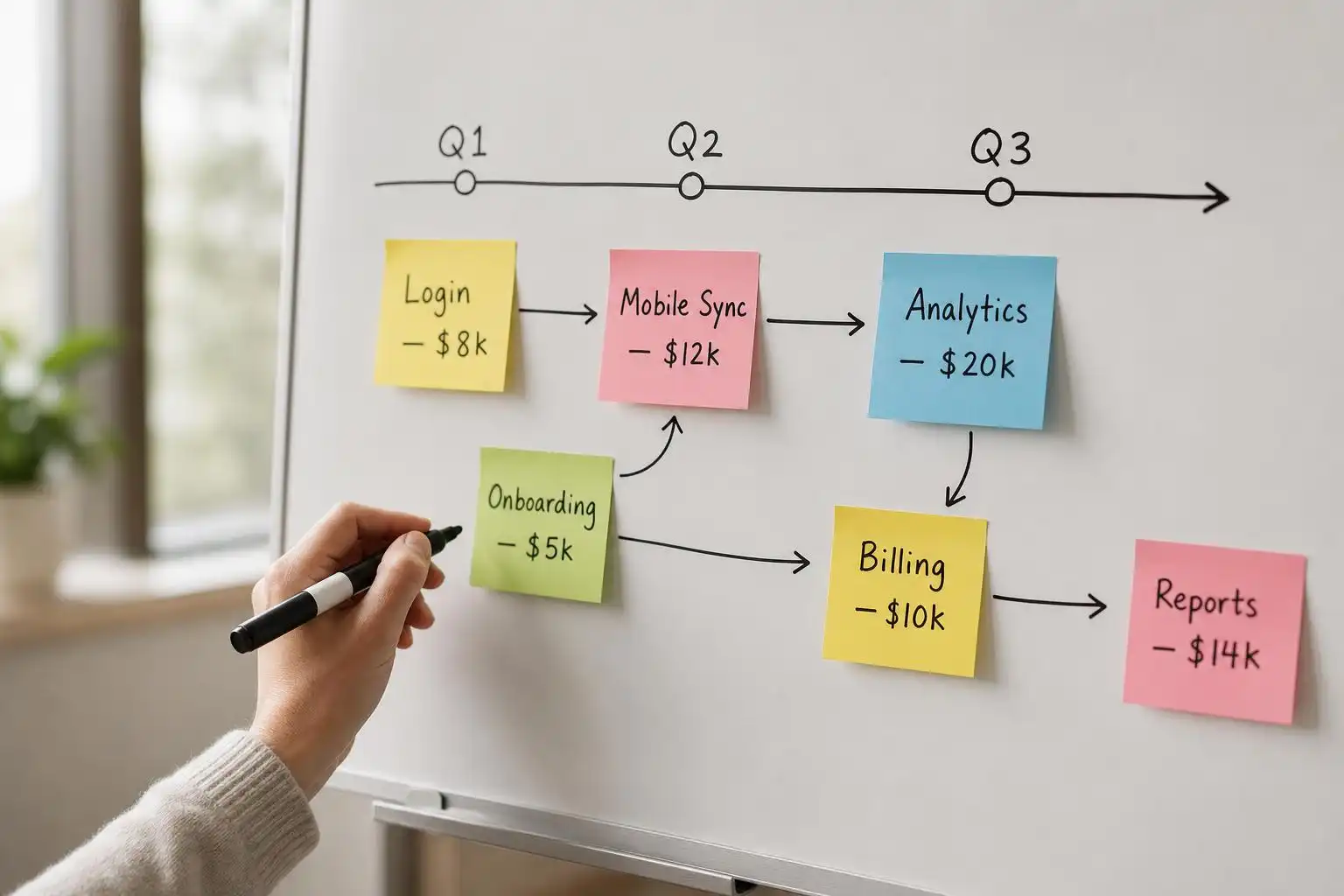
What Customer-Funded Development Actually Means
It does not mean building whatever the loudest customer asks for. That path leads to a Frankenstein product with 40 features that each serve one account and a churn rate that looks like a cliff.
It means structuring your business so that revenue precedes or coincides with the cost of building. Practically, that looks like:
- Annual prepayments that fund the next quarter of engineering time
- Paid pilots where a customer pays a reduced rate to get early access to a feature you’re building anyway
- Tiered upgrades where a new tier is announced before it’s fully built, and the first cohort of upgrades funds the build
- One-time “founding customer” add-ons for specific features, priced at 3–5x the eventual recurring cost
The common thread: cash in before or during development, not after.
The Annual Prepayment Engine
Annual contracts are the most underrated tool in the bootstrapper’s arsenal. A customer paying $2,400/year instead of $200/month gives you $2,400 on day one instead of $200. If you close 10 annual contracts in a quarter, that’s $24,000 in your account before you’ve written a line of new code.
Here’s how I use that float deliberately:
- Identify the next meaningful feature cluster — not a single button, but a capability that would move a customer from one tier to the next, or prevent a specific churn risk.
- Estimate the build cost — in my case, that’s usually 40–80 hours of my own time plus maybe $500–$1,500 in contractor work for design or QA.
- Calculate how many annual prepayments cover it — if a feature costs me $3,000 all-in (time valued at market rate), I want to see that covered by upgrades or new annual signups before I start.
- Offer a migration incentive — “Switch to annual before [date] and get [feature] in beta access” converts monthly customers and funds the build simultaneously.
Transistor.fm, the podcast hosting platform bootstrapped by Justin Jackson and Jon Buda, has talked publicly about using annual plan revenue to fund new infrastructure work. They didn’t raise a round to build out their analytics suite — they sold annual plans and used the float. That’s the model.
Paid Pilots: The Most Honest Form of Validation
A paid pilot is a short-term engagement — typically 60 to 90 days — where a customer pays a reduced rate (usually 30–50% of full price) to use a feature that isn’t finished yet. In exchange, they get hands-on onboarding, direct access to you, and the ability to shape the feature before it locks.
The math works like this: if your standard plan is $300/month and you run a 90-day pilot at $150/month, you collect $450. If you’re running three simultaneous pilots, that’s $1,350 in the bank before the feature ships. More importantly, you’ve got three customers actively using a half-built thing and telling you what’s broken.
The rules I follow for paid pilots:
- Never run more than three at once. More than that and the feedback becomes noise. You end up building for five different mental models simultaneously.
- Charge something, even if it’s small. Free pilots attract people who aren’t serious. A $50/month pilot still filters for intent.
- Write a one-page spec before you start. The pilot customer signs off on what you’re building. This isn’t a legal document — it’s a shared understanding. It prevents scope creep and gives you something to point to when they ask for a feature that wasn’t in the original scope.
- Set a hard conversion date. At the end of the pilot, they convert to full price or they leave. No indefinite pilots. No “let’s extend another month.” That’s how you end up with a customer paying $150/month forever for something priced at $300.
Tiered Upgrades as a Pre-Sale Mechanism
When you’re ready to launch a new tier, don’t wait until it’s fully built to sell it. Announce the tier, describe what it includes, and open early-access signups at the new price point. The first cohort of customers who upgrade funds the final 20% of the build.
This works because most of the value in a new tier is already built — you’re just packaging it differently and adding two or three net-new capabilities. The announcement gives you real market signal: if nobody upgrades in the first two weeks, you’ve learned something important before you’ve sunk another 40 hours into it.
Practical steps:
- Build 80% of the new tier before announcing. The core functionality should work. What’s missing are polish items and one or two headline features.
- Email your existing base with a specific, dated offer: “Upgrade to [Tier Name] before [date] and lock in $X/month. Price goes up after launch.”
- Set a minimum threshold. I don’t finish the build unless at least five customers upgrade. If I don’t hit five in two weeks, I either reprice, reframe the offer, or kill the tier and go back to the drawing board.
- Communicate transparently. Tell early upgraders what’s built and what’s coming. “You’re getting access now. [Feature A] is live. [Feature B] ships in 4 weeks.” Customers who buy into a roadmap are more forgiving than customers who feel misled.
Basecamp (now 37signals) has done versions of this for decades — launching products with a limited feature set, charging from day one, and using that revenue to fund the remaining build. Their public writing on this is worth reading in full.
The Founding Customer Add-On
This one is less common but extremely effective for larger features that don’t fit cleanly into a tier upgrade. The mechanic: you identify a specific capability that would be worth real money to a subset of your customer base, and you sell it as a one-time “founding customer” add-on before you build it.
Pricing: 3–5x the eventual recurring cost. If the feature will eventually be a $50/month add-on, the founding customer price is $150–$250 as a one-time fee. They pay once, get the feature forever (or for the life of their account), and you collect enough upfront to fund the build.
Why does this work?
- The one-time nature feels like a deal to the customer. They’re paying less over time than they would at recurring rates.
- You collect the cash now, not spread over 6–12 months.
- The customers who buy in are invested in the outcome. They’ll test it, give feedback, and tell other people about it.
I’ve used this for integrations specifically. An integration with a tool that 15% of my customer base uses is hard to justify at a recurring price point — the addressable market inside my existing base is too small. But if I can collect $200 one-time from 20 customers, that’s $4,000 to fund a build that costs me $2,500–$3,000. Positive ROI, zero external capital, and 20 customers who now have a deeper hook into the product.
Tracking the Model: Numbers That Matter
If you’re running customer-funded development, you need to watch a handful of metrics closely:
- Annual plan percentage: What share of your MRR is on annual contracts? I target 40% or higher. Below 30% and you don’t have enough float to fund meaningful development.
- Pilot conversion rate: What percentage of paid pilots convert to full price? Below 60% and something is wrong — either the feature isn’t landing, the pricing is off, or you’re attracting the wrong pilots.
- Feature-to-churn correlation: After shipping a customer-funded feature, does churn drop in the segment that requested it? If you built it for retention and churn doesn’t move, you built the wrong thing.
- Build cost vs. incremental MRR: Every feature should have an expected MRR impact — either new MRR from upgrades or retained MRR from reduced churn. If a feature costs $3,000 to build and generates $500 in incremental MRR, your payback period is 6 months. That’s fine. If it’s 18 months, you need a better reason to build it.
What This Model Protects You From
The venture-backed competitor can build features speculatively. They can spend $200,000 building something that might matter to customers and find out six months later that it doesn’t. They have the runway to absorb that mistake.
You don’t. And that constraint is actually a competitive advantage, not a weakness.
When every feature is pre-validated by customers willing to pay for it, your product has almost no dead weight. Every capability in your product is there because real customers paid for it. That makes your codebase smaller, your onboarding simpler, and your support load lower. It also makes your churn rate easier to understand — if a customer leaves, it’s not because they couldn’t find the feature they needed. It’s something else, and you can diagnose it.
Baremetrics, which has published its revenue dashboard publicly for years, has talked about the discipline of building only what customers are actively asking for and paying for. That discipline is what kept them profitable at a size where a funded competitor would have been burning $200K/month on speculative product bets.
Getting Started This Week
If you’re not running customer-funded development yet, here’s the minimum viable version to start this week:
- Identify your top three churn reasons from exit surveys or cancellation data. Pick the one that’s most commonly cited.
- Find five customers who churned for that reason and email them: “We’re building [solution]. Would you come back at [price] to be in the first cohort?”
- If three of five say yes, build it. If fewer than three say yes, either the price is wrong or the solution is wrong. Adjust and try again.
- Collect payment before you ship. Even a $50 deposit. The act of paying changes the relationship from “interested” to “invested.”
That’s it. No pitch deck. No investor meeting. No dilution. Your customers fund the product, the product retains the customers, and the business compounds from there.
That’s the whole model.



Leave a Reply