

Most SaaS advice assumes you’re spending someone else’s money. Growth-at-all-costs playbooks, “burn multiples,” CAC-to-LTV ratios calibrated for venture paybacks — none of it applies when the money in the bank is yours, and there’s no partner meeting where a bad quarter gets absorbed by a fund’s other bets. If you’re bootstrapped, your runway isn’t a metric you report. It’s the thing standing between you and having to shut down or take a job you don’t want.
I’ve spent years watching indie founders treat cash buffer as an afterthought — something you build “once things stabilize” — instead of the first infrastructure decision they make. That’s backwards. A twelve-month cash buffer isn’t conservative hoarding. It’s the single asset that lets you make every other decision — pricing, hiring, feature bets — from a position of strength instead of panic.
Why Twelve Months, Not Six
Six months of runway is the number that gets thrown around in most startup content, and it’s a VC-world number: enough time to hit a milestone before the next raise. Bootstrappers don’t have a next raise. If revenue dips for two consecutive months — a big customer churns, a seasonal slump, an ill-timed price increase — you need enough runway to absorb it, diagnose it, and fix it without making decisions out of fear.
Twelve months gives you room to run an actual experiment cycle. Say your SaaS does $18,000 MRR and your all-in monthly burn (salaries, tools, hosting, your own draw) is $14,000. A six-month buffer is $84,000. A twelve-month buffer is $168,000. That extra $84,000 sounds like dead capital sitting in a business checking account. It isn’t. It’s the difference between raising prices with conviction and raising them out of desperation three weeks before you can’t make payroll.
Baremetrics founder Josh Pigford has talked publicly about the psychological toll of running lean without a buffer — every dip in MRR becomes a five-alarm fire instead of a data point. Compare that to someone like Jason Cohen at WP Engine (bootstrapped in its early years before later raising), who has written extensively about capital efficiency as a competitive advantage: the ability to wait out a bad market when your competitors, burdened by investor timelines, cannot.
What Counts as Runway (And What Doesn’t)
A lot of founders inflate their runway number by including revenue they haven’t collected yet or by using gross MRR instead of net cash. Runway is not “months until MRR hits zero.” It’s months until your bank balance hits zero, given your actual cash burn — the number after refunds, after payment processor fees, after taxes you owe but haven’t paid yet.
If you’re on annual contracts, don’t count deferred revenue as available cash unless it’s already been recognized and isn’t earmarked for refunds. I’ve seen founders get burned here specifically: a SaaS with $40,000 in the bank felt safe because $25,000 of that was prepaid annual subscriptions from three enterprise customers. When two of those customers asked for refunds after a rocky onboarding, the founder was suddenly staring at $15,000 against $12,000 in monthly burn — one month of real runway, not the four they thought they had.
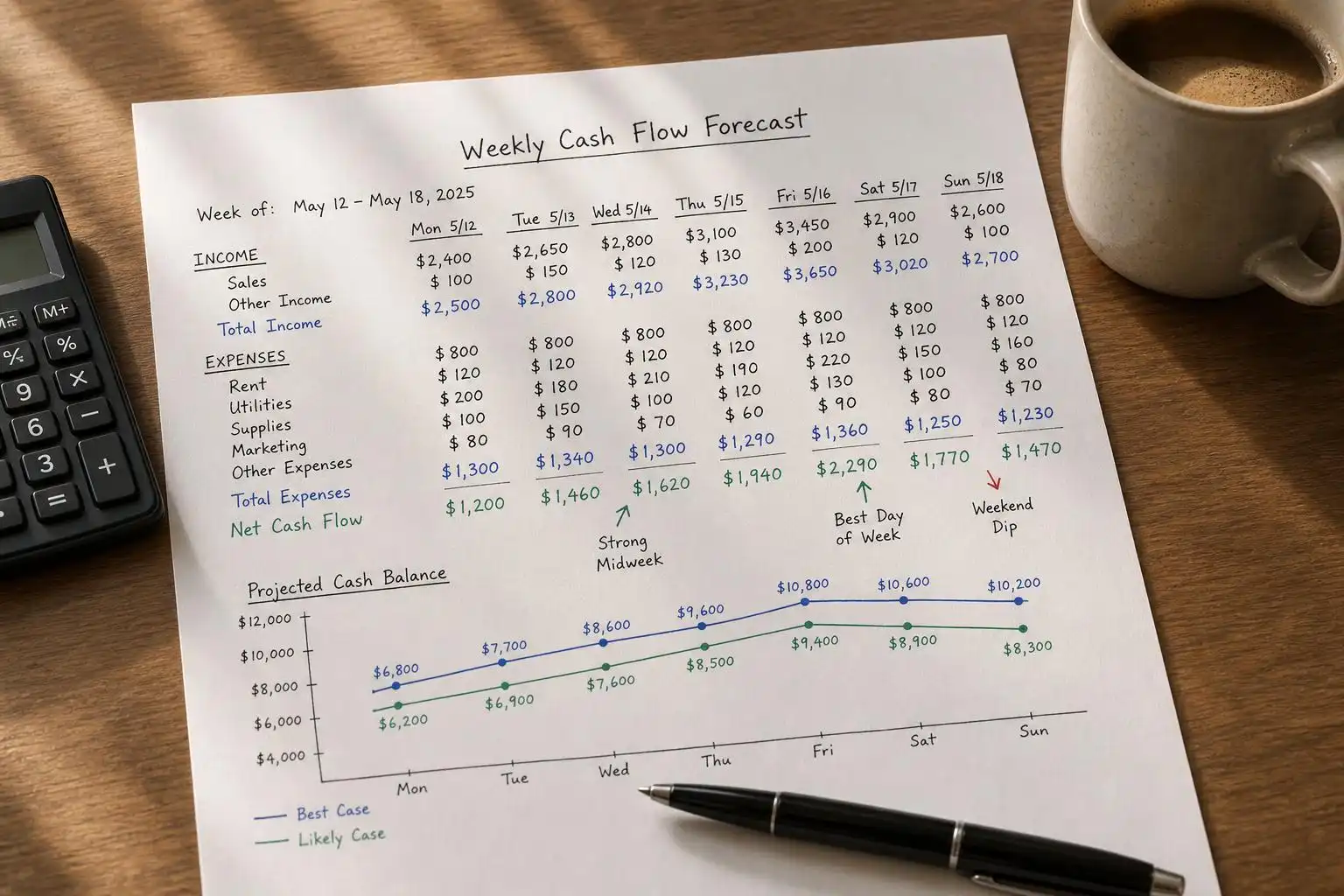
The fix is simple bookkeeping discipline: keep a rolling 13-week cash flow forecast, updated weekly, that separates collected cash from booked revenue. Tools like Float or even a maintained spreadsheet work fine — this isn’t a problem that needs software, it needs a habit. Update it every Monday morning. Ten minutes, non-negotiable.
The Buffer Changes What You’re Willing to Say No To
Here’s the part that doesn’t show up in the “why you need runway” posts: the buffer’s real value isn’t the money itself, it’s the option value it creates. When you have twelve months of runway, you can say no to a customer demanding a discount, no to a feature request from your loudest but least profitable account, no to an acquisition offer that undervalues what you built.
Basecamp — before Jason Fried and DHH became the poster children for anti-VC sentiment — operated for years with enough cash cushion that they could ignore trends entirely. They didn’t chase mobile-first redesigns when everyone else was scrambling, because nobody was forcing their hand on a fundraising timeline. Contrast that with companies that raised a Series A on a growth story: they’re structurally required to say yes to whatever juices the metric investors care about that quarter, even when it damages long-term unit economics.
For a one- or two-person SaaS, this plays out at a much smaller scale but the mechanism is identical. If you have three months of runway, you’ll take the client who wants twenty custom integrations because you need the $2,000/month. If you have twelve, you can tell that client no and spend the time instead on the feature your best 40 customers are actually asking for. The buffer doesn’t just protect you from disaster — it protects your roadmap from your own desperation.
Building the Buffer Without Starving the Business
The obvious objection: how do you build a $168,000 buffer without either raising money or strangling your own growth? The answer is a fixed savings rate applied to revenue, treated with the same seriousness as payroll.
Start with a target: 20% of net revenue, banked automatically, every month, before you touch it for anything else — before tool upgrades, before conference travel, before your own bonus draw. If your SaaS is doing $10,000 MRR, that’s $2,000 a month into a separate high-yield savings account, untouched. At that rate, reaching a $120,000 buffer (roughly twelve months of a $10k burn business) takes five years if MRR stays flat — which is why the buffer-building rate should scale with growth, not stay fixed in dollar terms.
A more aggressive version, which I’ve seen work for solo founders past $15,000 MRR: bank 100% of revenue growth above your last quarter’s baseline for two quarters after any price increase or new tier launch. If you raised prices and MRR jumped from $12,000 to $15,000, that extra $3,000 a month goes straight to the buffer account, untouched, for six months. You keep operating on the old baseline. This does two things — it builds the buffer fast during the exact moments cash is most available, and it stress-tests whether the growth is durable before you start relying on it for payroll or hiring decisions.
Pieter Levels, who runs Nomad List and Remote OK solo, has talked about keeping burn absurdly low specifically so that revenue volatility never threatens the business — no office, no team payroll to make, minimal fixed costs. That’s one way to solve the buffer problem: shrink the burn side of the equation so the runway math becomes trivially easy. Not every business can run that lean, but the principle transfers — every fixed cost you add (a hire, a bigger tool stack, an office) is a permanent tax on your runway math, and should be weighed against how many months of buffer it costs you, not just whether you can “afford” it in a given month.
When to Spend the Buffer (And When Not To)
A cash buffer that never gets touched isn’t serving its purpose either — it’s just an insurance policy you’re paying for and never using. The buffer exists to be spent on things that either extend the runway further or remove an existential risk, not on convenience purchases that happen to be affordable.
Legitimate uses: covering a bad month caused by seasonal churn while you fix the underlying retention problem (see any tiny team’s Q1 slump after holiday-season signups lapse); funding a deliberate, time-boxed customer development sprint — say, eight weeks of your own time paid for out of the buffer to build a feature three enterprise prospects have said would get them to sign, rather than raising a round to hire it out; buying yourself decision-making time during an acquisition offer instead of being forced to answer in two weeks because you need the payout.
Illegitimate uses, the ones I’d flag hardest: hiring ahead of revenue because a hire “feels overdue,” upgrading your own lifestyle spend because the balance looks healthy, or funding paid acquisition experiments that don’t have a clear payback window. The buffer is not working capital for growth bets — that’s what current revenue and profit margin are for. Confusing the two is how founders quietly drain a year of safety net chasing a growth initiative that, had it been funded from cash flow instead, would have been sized appropriately from the start.
A useful test: before spending from the buffer, ask whether the expense reduces risk to the business’s survival or increases the business’s exposure. Fixing a churn problem reduces risk. Hiring a second developer before you’ve validated demand for the next tier increases exposure. If you can’t clearly answer which side of that line the expense falls on, it comes out of monthly cash flow instead, sized to what current revenue can actually support — not the buffer.
The Buffer Is a Founder Mental Health Tool First, a Business Tool Second
I’ll end on the part that’s harder to quantify but matters more than any of the math above. Every bootstrapped founder I’ve talked to who ran without a real buffer describes the same thing: constant background anxiety that colors every decision, every customer email, every slow week. That anxiety makes founders worse at their jobs — worse at pricing conversations, worse at saying no, worse at building the patient, compounding kind of product that bootstrapped companies are supposed to be good at.
The twelve-month buffer isn’t just a number on a balance sheet. It’s what lets you read a churn email at 11 p.m. and go back to sleep instead of lying awake recalculating your burn rate. Build it deliberately, protect it fiercely, and spend it only when the alternative is real risk — not convenience. Everything else about running small and staying independent gets easier once that number exists.



Leave a Reply