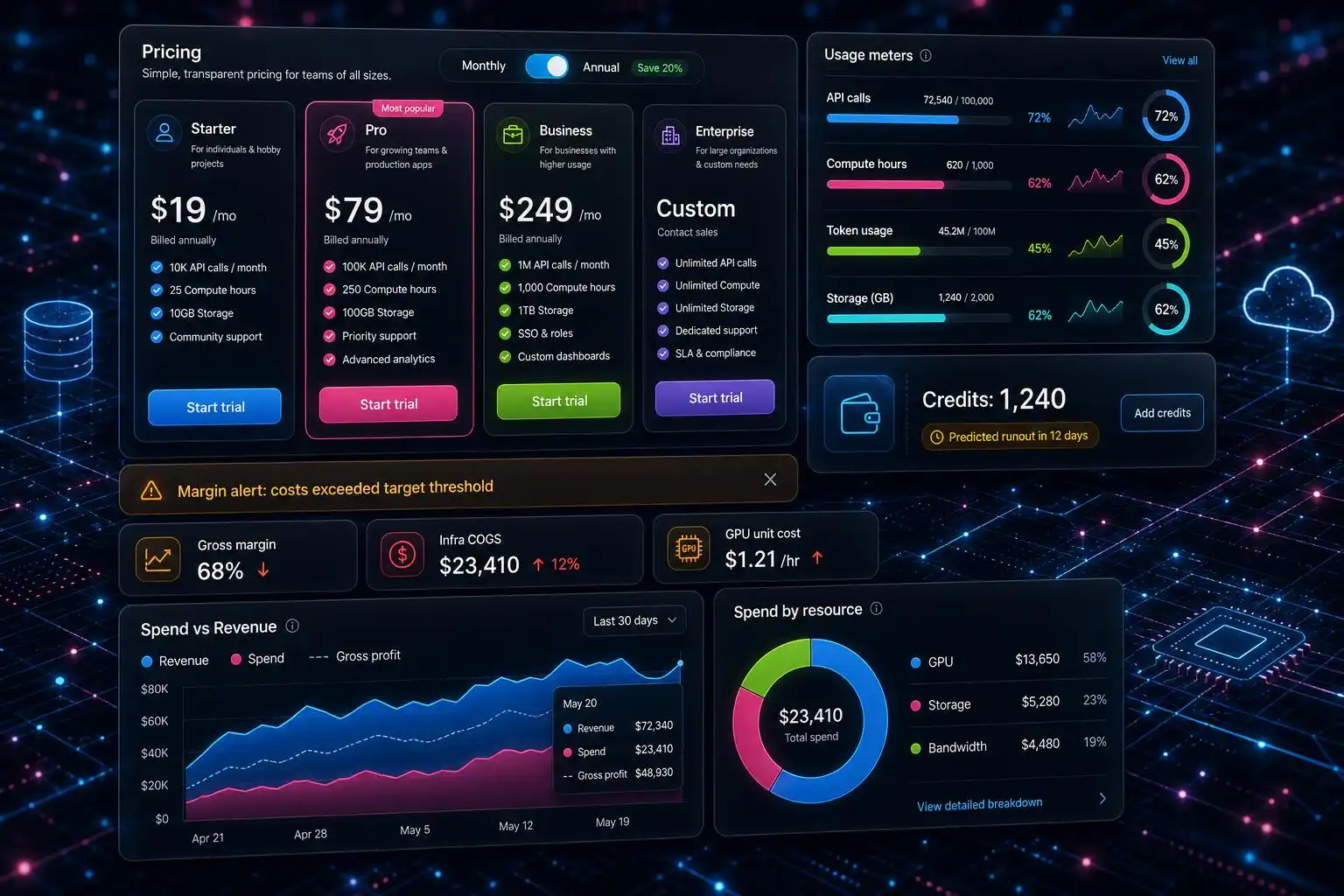

A funny thing happens when software becomes easier to build: the pricing conversation gets harder, not easier.
I’m seeing this in founder calls almost every week. A team has shipped an AI-assisted MVP in days. They have a handful of users, maybe a few early customers, and a cost dashboard that makes everyone slightly nauseous. The product feels magical, but the business model is foggy. Should it be $19/month? Credits? Seats plus usage? Enterprise contracts? Free until traction?

The old SaaS instinct says: pick three tiers, anchor the middle one, and move on. That was never as simple as people pretended, but it was workable when marginal software costs were near zero. AI has changed the math. Inference, API calls, compute, hosted agents, and support load now create real cost-of-goods-sold inside products that used to behave like pure software. Modern subscription platforms increasingly support pay-as-you-go, hybrid subscriptions, prepaid credits, seat-based plans, mid-cycle changes, custom contracts, and real-time metering because SaaS pricing has become operationally more complex.[1]
The strategic question is no longer “Which pricing model is trendy?” It is: what unit of value does the customer understand, what unit of cost can you survive, and where do those two curves stop lining up?
The code is less of the moat. The business system is more of it.
There is a noisy but useful debate happening around “vibe-coded” SaaS: if buyers can generate a custom internal tool quickly, why buy from a vendor at all? One Hacker News thread framed the counterargument bluntly: the value in SaaS was never just the code; it was integrations, contracts, expertise, reputation, ongoing operations, and making the problem someone else’s responsibility.[7]
That is exactly right from a pricing perspective.
If your only value proposition is “we wrote the code so you don’t have to,” AI compresses your pricing power. If your value proposition is “we absorb the operational risk, maintain the workflow, keep the integrations alive, handle compliance, support the team, and produce a business outcome,” you still have something customers will pay for.
This is why pricing should not start with your feature list. It should start with your buyer’s alternative:
- Could they build this internally?
- Would they trust the internal version?
- Who maintains it after the first demo?
- What happens when the API changes, the model cost spikes, the workflow breaks, or an employee leaves?
- What business metric improves if they use you instead?
The cheaper it gets to create software, the more your price has to attach to confidence, continuity, and outcomes.
Value-based pricing is still the north star, but AI needs a cost floor.
Value-based pricing means setting prices according to the outcomes and ROI customers receive, not simply according to your costs or competitor benchmarks.[2] I still consider it the best strategic lens for SaaS packaging. If your product saves a support team 400 hours a month, generates qualified pipeline, reduces fraud, accelerates engineering throughput, or prevents churn, you should price against that value.
But AI products need one extra discipline: never let value-based pricing ignore the cost floor.
A useful early-stage test is brutally simple: if a customer uses your product every day, do you still make money? Founders monetizing new AI-heavy apps are being told to account for inference, APIs, compute, hosting, support, payment costs, refunds, and the possibility that usage-based billing or credits may be necessary to keep the business sustainable.[4]
That advice sounds basic until you look at how many AI startups accidentally sell an all-you-can-eat buffet to the hungriest users in the room.
The trap looks like this:
- You launch a simple subscription because simplicity converts.
- Power users discover the product is dramatically useful.
- Their usage grows faster than their subscription revenue.
- Your best customers become your worst-margin customers.
- You either throttle them, reprice them, or quietly hope the infrastructure bill stops climbing.
Hope is not a pricing model.
The best AI pricing has a subscription spine and usage shock absorbers.
The pricing pattern I recommend most often now is not pure usage-based pricing. It is hybrid pricing with a clear subscription spine.
The subscription buys access, reliability, workflow continuity, admin controls, integrations, support, and a reasonable included allowance. Usage pricing handles variance. This can show up as overages, prepaid credits, metered actions, model-specific consumption, or premium compute buckets. Hybrid pricing is growing because it combines the predictability of subscriptions with the fairness and margin protection of usage-based pricing.[1]
Why not pure usage? Because many B2B buyers dislike open-ended bills. They need a budgetable commitment. They also need a reason to believe your product is a system of record or workflow, not just a meter running in the background.
Why not pure subscription? Because your cost curve may not care about your beautiful pricing page.
The current AI tooling market is giving founders a live demonstration. In one recent Hacker News discussion about model access moving through usage credits, users debated whether advanced model usage should remain bundled in subscription tiers or move to usage-only pricing; one commenter described being willing to spend far more on AI coding if it accelerated growth, while another noted that the effective cost could become dramatically higher once premium access shifted out of the subscription bundle.[6]
That conversation captures the core tension: heavy users may have very high willingness to pay, but they hate surprise and they punish confusing communication. If you change the deal, you are not just changing price. You are changing trust.
Credits are useful, but they are not a strategy by themselves.
Credits are the duct tape of AI SaaS pricing. Sometimes that is a compliment.
They are useful when:
- The underlying cost unit is too technical for buyers.
- Different actions have different cost profiles.
- You want prepaid cash flow.
- You need to cap downside risk.
- You want customers to experiment without making every click feel like a toll booth.
But credits fail when customers cannot predict what they will get for them. “10,000 credits” means nothing unless the buyer can translate it into workflows: documents processed, agents run, tickets resolved, reports generated, videos rendered, tests executed, or pull requests reviewed.
If you use credits, pair them with examples:
- “Starter includes roughly 200 standard document reviews per month.”
- “Pro includes 1,000 agent tasks using standard models.”
- “Premium model runs consume 5x credits and are best for complex reasoning workflows.”
- “You will receive alerts at 75%, 90%, and 100% of included usage.”
The buyer does not need your internal token math. They need a believable forecast.
Segmentation should follow willingness to pay, not your infrastructure diagram.
The most common packaging mistake I see in AI SaaS is exposing the vendor’s cost structure too directly. Customers do not wake up wanting to buy tokens, API calls, or compute seconds. They want recruiting screens completed, contracts reviewed, incidents resolved, campaigns launched, code migrated, invoices reconciled.
Use cost units for internal margin management. Use value units for packaging.
A practical segmentation map might look like this:
Individual / maker tier
- Low commitment
- Strict usage cap
- Limited support
- No admin complexity
- Great for adoption, not margin heroics
Team tier
- Subscription per workspace or seat
- Included monthly usage
- Collaboration and shared context
- Simple overages or top-up credits
- Budget alerts
Business tier
- Higher included usage
- Priority queues or better models
- Integrations
- Admin controls
- Audit history
- Higher support expectations
Enterprise tier
- Custom contract
- Security and compliance
- SSO, SCIM, data controls
- Dedicated capacity or committed usage
- Negotiated rates
- Invoicing, procurement, and legal support
This is not just “good, better, best.” It is a willingness-to-pay curve. Each tier should answer a different risk profile. Small customers buy speed and affordability. Mid-market teams buy collaboration and predictability. Enterprises buy control, governance, and contractual assurance.
Your billing system is part of the product promise.
Founders underestimate how quickly pricing complexity becomes an operations problem.
The moment you introduce hybrid pricing, you need to support metering, proration, plan changes, discounts, renewals, add-ons, invoices, taxes, payment failures, and customer-specific terms. Subscription management guidance increasingly emphasizes real-time event metering, custom pricing, mid-cycle upgrades and downgrades, multi-entity invoicing, tax compliance, automated renewals, and dunning workflows to reduce billing errors and revenue leakage.[1]
For enterprise SaaS, the metering layer deserves special scrutiny. A billing system for hybrid models may need to handle seat fees plus metered overages, prepaid credit wallets, graduated tiers, volume thresholds, audit-grade aggregation, and high-volume event ingestion without drift.[5]
This matters because billing mistakes are not back-office trivia. They create pricing distrust. If customers cannot reconcile what they used, what they were charged, and why, your clever pricing model becomes a churn driver.
Before launching a complex AI pricing model, ask:
- Can customers see current usage before the invoice arrives?
- Can finance reproduce an invoice from raw events?
- Can sales quote custom contracts without engineering intervention?
- Can customer success identify accounts approaching limits?
- Can you change packaging without a six-week billing migration?
- Can you distinguish a healthy power user from an abusive margin leak?
A pricing model you cannot operate is just a landing page fantasy.
The early-stage rule: simple offer, instrumented economics.
For a new product, do not overfit pricing before you have evidence. Simplicity matters more than precision at launch; the goal is a clear offer that lets you learn whether customers will pay.[4]
But “simple” should not mean “blind.”
My preferred first version for many AI SaaS products is:
- One free trial or low-friction entry path.
- Two or three paid plans.
- A clear included usage allowance in each plan.
- Hard or soft limits depending on buyer expectations.
- Transparent top-ups or overages.
- Internal cohort reporting on gross margin by account.
You are trying to learn four things:
- Which segment converts fastest?
- Which segment retains?
- Which segment expands?
- Which segment destroys margin?
That fourth question is now just as important as the first three.
A pricing page should reduce anxiety, not display optionality.
If your pricing page requires a spreadsheet to understand, it is not sophisticated. It is unfinished.
Good AI pricing pages answer the buyer’s silent objections:
- “What do I get?”
- “What happens if I use more?”
- “Will my bill explode?”
- “Can I start small?”
- “Can my team grow into this?”
- “Is this priced for my company size?”
- “Why is the enterprise plan custom?”
Bad pricing pages make customers reverse-engineer your infrastructure. They say things like “includes 8 million tokens” without explaining what that means in human work. They bury overage rates. They use credits but hide consumption multipliers. They advertise unlimited usage and then throttle aggressively in the fine print.
Clarity is not the enemy of monetization. Clarity is what lets customers self-select into the right package.
The durable moat is packaging judgment.
AI will keep lowering the cost of building software. It will also increase the number of products that reach the market with weak positioning, underpriced usage, and confused packaging.
That is good news for founders who take pricing seriously.
The winners will not simply be the teams with the best model access or the slickest demo. They will be the teams that understand where customers perceive value, where costs scale, where trust can break, and how to package the product so each segment feels both safe and fairly charged.
In the old SaaS era, bad pricing left money on the table.
In the AI SaaS era, bad pricing can eat the table.
References
- B2B SaaS Subscription Management: Best Practices and Strategies — https://getlago.com/blog/subscription-management-best-practices-and-strategies
- A Complete Guide to SaaS Pricing Models and Strategies — https://5ly.co/blog/saas-pricing-models-and-strategies
- How to monetize your vibe-coded app; pricing, payments and your first customers — https://www.paddle.com/resources/how-to-monetize-your-app
- Enterprise SaaS Billing: What You Actually Need (2026) — https://getlago.com/blog/enterprise-saas-billing
- Fable 5 is Back – Hacker News — https://news.ycombinator.com/item?id=48752030
- I think this is pretty spot on. It’s already been mentioned a ton before how man… — https://news.ycombinator.com/item?id=47174722



Leave a Reply