

The healthiest open-core companies I know do something that sounds almost backwards: they make the paid version boring.
Not weak. Not underpowered. Not forgettable. Boring in the sense that the paid product is not a bag of shiny tricks designed to make the community edition feel artificially broken. It is boring the way procurement is boring, the way audit logs are boring, the way SSO is boring, the way indemnity is boring. It solves the operational, organizational, and risk problems that appear when software moves from “a team likes this” to “the company depends on this.”
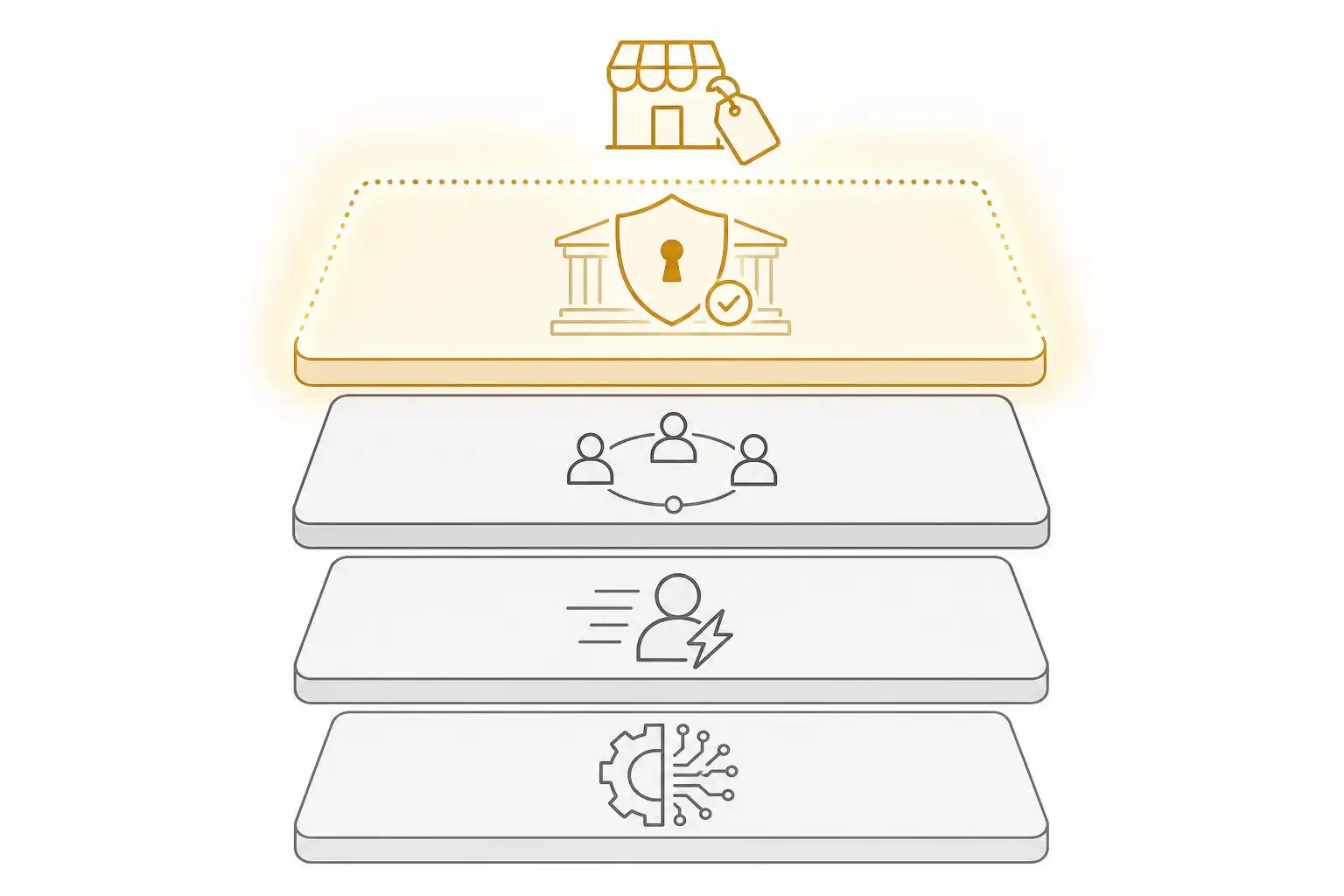
That distinction matters because open-core businesses usually fail in one of two ways.
They either give away so much that there is no credible reason for a serious customer to pay, or they hold back so much that the free project no longer feels like a real project. The first path creates admiration without revenue. The second creates revenue pressure without trust.
The answer is not to find a cleverer paywall. It is to understand what kind of value belongs to the individual practitioner, what kind belongs to the team, and what kind belongs to the institution.
The community edition should be complete for its natural user
A good free edition is not a demo. It is not a lead magnet wearing an Apache license. It should be complete for the person or small team using it in the way open-source software is normally adopted: locally, experimentally, independently, and without asking permission.
If your database, observability tool, workflow engine, CMS, or developer platform cannot do its core job without a paid feature, users will feel it immediately. They may not object in business language, but they will understand the posture: “We want the credibility of open source, but not the consequences.”
That is a dangerous message.
The free version should let a skilled user solve the primary technical problem. It should be useful in production for teams that are comfortable operating it themselves. It should create genuine practitioners, not just prospects. If the only people who love your project are people who have not hit the paywall yet, you do not have community goodwill. You have deferred disappointment.
This does not mean everything must be free. It means the boundary should not cut through the heart of the user’s first successful outcome.
For example, it is usually a mistake to charge for:
- the basic runtime or server that makes the project valuable;
- core APIs required for normal integration;
- reasonable local development workflows;
- basic documentation, examples, or SDKs;
- features that prevent lock-in to your hosted service.
Those are not premium conveniences. They are the minimum conditions for trust.
Paid features should map to organizational cost
The cleanest commercial boundary is not “advanced versus basic.” It is “personal productivity versus organizational responsibility.”
A developer may need your project to ship a service. A company needs it to survive employee turnover, security review, compliance audits, budget cycles, regional expansion, and incident response. Those are different jobs.
This is where paid features become not only acceptable, but expected. Enterprises do not pay because they are morally obligated to support open source. They pay because the free version transfers work onto them, and at sufficient scale that work becomes expensive.
The best enterprise features reduce that transferred work.
Think about SSO. Technically, authentication is a feature. Commercially, it is a governance control. A five-person startup can manage users manually. A 5,000-person company cannot. The value is not that SSO is “more advanced.” The value is that it lets the buyer enforce identity policy without inventing a workaround.
The same is true for role-based access control, audit logs, SCIM provisioning, data retention controls, private networking, high availability automation, backup management, admin dashboards, policy enforcement, and compliance reports. These features do not make the underlying product more fun. They make adoption less risky.
That is why boring paid features are powerful. They are attached to budget owners who already understand the cost of not having them.
Do not charge for pain you created
There is a line that open-core founders cross when they are under pressure: they degrade the free product and then sell relief.
This shows up as artificial limits that have nothing to do with cost or enterprise complexity. A missing export button. A crippled API. A single-user limit that makes no sense for the software’s natural use case. A community edition that can technically run in production, but only if the user accepts avoidable fragility.
Users can tell the difference between “this is paid because it serves a different buyer” and “this is paid because the vendor needed leverage.”
The first can build a durable business. The second creates resentment, forks, and a permanent tax on your reputation.
A useful test is this: if a competent team could reasonably build the feature themselves to satisfy their own internal needs, and your paid version saves them time, you are probably on solid ground. If the feature is only missing because you removed it from an otherwise natural workflow, you are probably charging for pain you created.
Another test: would you feel comfortable explaining the boundary in public to your most committed community users? Not in a pricing page euphemism. In plain language.
“We charge for this because large organizations need centralized identity, auditability, and policy controls.” That is defensible.
“We charge for this because otherwise too many people would be happy on the free version.” That may be true, but it is not a strategy you can build trust around.
The buyer is not always the user
Open-source adoption often starts with a practitioner and ends with an institutional buyer. The mistake is treating those people as if they value the same things.
The practitioner wants power, elegance, speed, extensibility, and control. They want the project to respect their competence. They do not want to be forced into a sales conversation before they understand the software.
The institutional buyer wants predictability, accountability, integration with existing systems, and someone to call when the software becomes important. They do not want a heroic internal maintainer to be the only reason a critical system works.
Your packaging should reflect this split.
The community edition should win the practitioner honestly. The paid edition should reassure the organization honestly. When those motions are confused, the product starts behaving strangely. You get “enterprise” features that developers hate and “community” restrictions that buyers do not care about.
A common symptom is hiding collaboration too early. Collaboration can be a legitimate paid boundary in some categories, especially where team administration and shared controls create real organizational value. But if collaboration is central to the product’s basic purpose, charging for the second seat may sabotage adoption before the buyer ever appears.
The question is not “Can we monetize teams?” Of course you can. The question is “At what point does a team’s usage create institutional value rather than simply normal product usage?”
That point is different for every category. A developer tool used by three engineers on one service may still be practitioner-led. A security platform used by three engineers may already involve policy, access, and audit requirements. Pricing has to follow the operating reality, not a generic seat-based template.
Enterprise value is often about time horizons
One of the clearest differences between free and paid usage is time horizon.
Free users often optimize for today: can I install it, understand it, make it work, and solve the problem in front of me?
Enterprise buyers optimize for the next three years: can we standardize on it, secure it, train people on it, survive an audit, migrate workloads, and avoid a rewrite?
This is why long-term maintenance can be commercial value, but only if packaged carefully. “Pay us or the project will be neglected” is not a healthy message. “Pay us for certified builds, lifecycle guarantees, compatibility promises, backported fixes, and contractual support windows” is different. The first is a hostage note. The second is an enterprise product.
The same applies to cloud offerings. Hosting is not automatically the business model. Many users will pay for a managed service because they do not want to operate infrastructure. Others will self-host forever, either because of cost, regulation, latency, or philosophy. Your commercial design should not punish the second group for existing. It should make clear what operational burden they are choosing to carry.
A strong paid cloud offering says: “You can run this yourself. If you would rather not, we will run it better than you can justify doing internally.”
That is a much stronger position than: “We made self-hosting awkward so the cloud looks better.”
A practical framework for the open-core line
When I work through packaging with founders, I like to sort features into four buckets.
1. Core capability
This is what the project is fundamentally for. If you remove it, the software becomes a toy or a trial. Core capability usually belongs in the open version.
2. Individual acceleration
These are features that make one user faster or happier: nicer workflows, templates, local tools, quality-of-life improvements. Be careful here. Some can be paid, especially in desktop or prosumer products, but in infrastructure and developer tools this bucket often drives adoption. Monetizing too aggressively here can shrink the community before it compounds.
3. Team coordination
This includes shared workspaces, permissions, comments, approvals, project-level controls, and collaboration history. Some of this may be commercial, but the boundary should respect how the product is naturally used. If teams cannot experience the product’s value without paying, your adoption motion becomes sales-led whether you admit it or not.
4. Institutional control
This is where open-core monetization is usually strongest: SSO, SCIM, RBAC, audit logs, compliance, governance, advanced security, deployment controls, admin reporting, support commitments, legal terms, and lifecycle guarantees. These features map to organizational risk and budget.
The mistake is treating all four buckets as equal candidates for monetization. They are not. The closer a feature is to core capability, the more scrutiny the paywall deserves. The closer it is to institutional control, the easier it is to charge without damaging the project’s integrity.
Free should create conviction, not dependency
There is a subtle but important difference between a free user who has conviction and a free user who is trapped.
Conviction sounds like: “This project solved a real problem. We trust it. Now that more of the company depends on it, paying for the enterprise version makes sense.”
Dependency sounds like: “We built around this, and now we have to pay because the vendor controls a missing piece.”
Both can produce revenue in the short term. Only one produces advocates.
Open-core companies depend on advocates more than they sometimes admit. The person who brings your project into a company is often not the economic buyer, but they are the internal source of truth. If they feel tricked, your sales team inherits a credibility problem. If they feel respected, they become the bridge between community trust and commercial adoption.
That bridge is the business.
The paid version should feel inevitable
The best upgrade moment is not a surprise. It is the moment when the user’s environment has changed.
A team grows. A second department adopts the tool. Security asks for audit logs. IT asks for SSO. Finance asks who owns the vendor relationship. Legal asks about data processing terms. Operations asks about uptime. Nobody is angry that these things cost money, because the need has moved from software functionality to organizational assurance.
That is the moment your paid edition should meet.
Not with guilt. Not with a “support the project” plea. Not with a paywall placed where the user expected a normal feature. With a product that says: you have made this important; here is what it takes to make it safe, governed, and durable.
Boring, in other words.
And boring is underrated. Boring is where budgets live. Boring is where renewals come from. Boring is how an open-source project becomes infrastructure without betraying the people who believed in it first.



Leave a Reply