
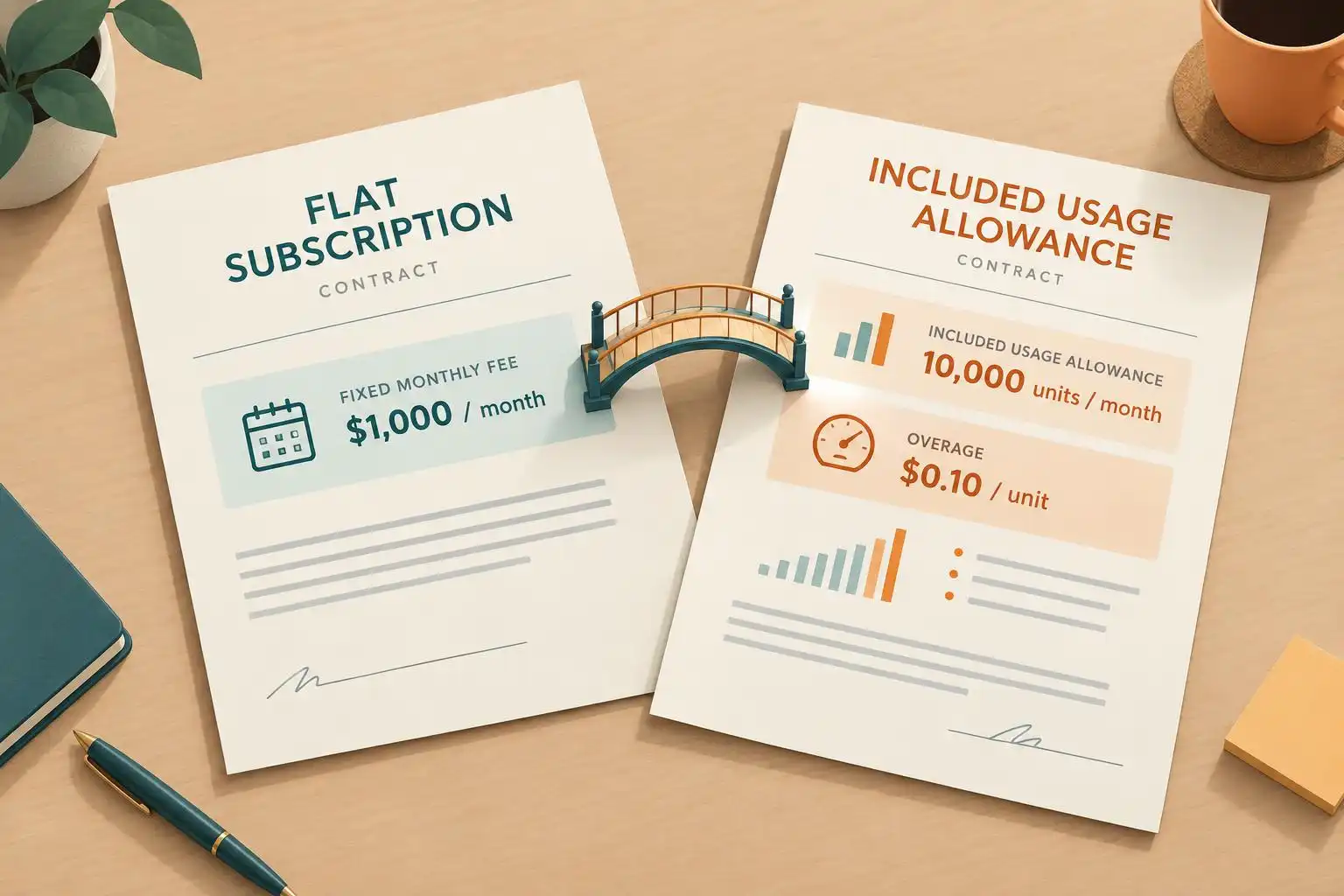

A new pricing model can look excellent on a slide and still fail the first time an existing customer asks, “What happens to my bill?” That question is not resistance to change. It is a request to reconcile a new price with an old promise.
For founders moving from flat subscriptions toward usage-based pricing, renewals are the hard part. New customers can evaluate the offer as presented. Existing customers remember the unlimited workflows, included reports, or generous allowances that made them sign. If you treat renewal as an administrative date for swapping rate cards, you turn a pricing improvement into a trust problem.
Separate the target model from the transition plan
Suppose a customer pays $24,000 a year for unlimited document processing. Your target package is now $18,000 a year plus $0.40 per document above an included volume. That structure might better reflect value and cost. It does not follow that this customer should receive it, unchanged, at renewal.
Run the target package on new customers first. You will learn whether buyers understand the value unit and can estimate their likely spend without asking sales to build a spreadsheet. Lago recommends using new customers as a clean room, then building a bridge for existing accounts rather than reopening what they already bought.[1]
That distinction gives you two separate questions: Is this the right long-term price? and What is a fair path from the current contract to it? A founder who answers only the first will often end up improvising discounts to solve the second.
Model the customer’s bill before proposing the change
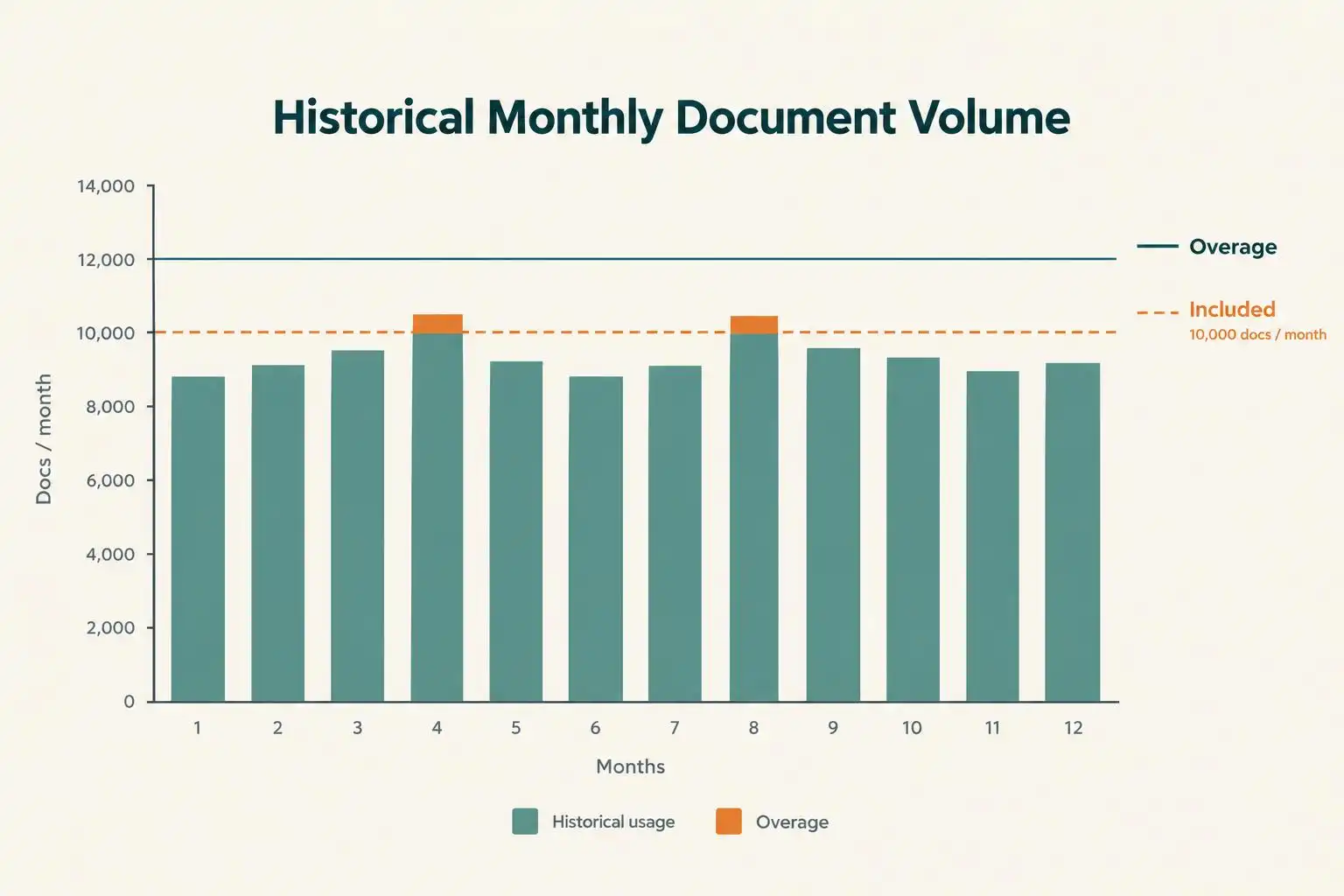
Do not lead a renewal conversation with an average percentage increase. Model what the customer would have paid under the proposed terms across a quiet month, a typical month, and a peak month. Use their actual historical usage where you can, and clearly label any assumptions about future growth.
Then look for the uncomfortable cases. Does the customer pay substantially more while doing exactly the same work? Would a seasonal spike create a bill their budget owner could not have predicted? Can the account team explain the increase in terms of additional value, or only in terms of your rising inference costs?
This matters because usage pricing is spreading alongside AI products, but adoption does not make surprise invoices acceptable. A Stripe executive, as reported by SaaStrAI, emphasizes showing customers consumption before a bill arrives.[3] At renewal, a forecast is the first version of that visibility. It lets both sides negotiate against a plausible range rather than a reassuring but meaningless “you should be fine.”
Give legacy customers a bridge, not a loophole
Grandfathering every old account forever preserves goodwill today but can leave your pricing disconnected from the product customers now use. An immediate migration may fix the economics faster, but it asks buyers to absorb all the uncertainty at once.
A bridge should make the destination clear while limiting the first step. Depending on the account, you might:
- Preserve the existing entitlement until its contracted term ends, while pricing a newly introduced capability under the new model.
- Offer a one-year usage allowance based on historical volume, then review the allowance together before renewal.
- Set a temporary cap on overages, with agreed alerts before consumption approaches it.
These are transition terms, not permanent secret plans. Record their expiration dates and explain what follows. Otherwise, next year’s account team inherits a collection of promises no one can find in the pricing documentation.
Make the usage number defensible
A renewal proposal based on “documents processed” needs an exact definition of a document. Is a retry counted twice? What happens when an upload fails? Do test runs count? The customer should not have to discover those answers by disputing an invoice.
Product, billing, finance, and the customer need to see the same usage figure. Lago identifies that shared, auditable number as a requirement of a successful transition.[1] Before rollout, put the billable-event definition, exclusions, and correction process in writing. Give customers a way to inspect consumption during the term, not just after it closes.
This is also why a value unit must survive contact with procurement. Buyers evaluate commercial models in terms of commitments, discounts, tiers, and true-ups—not just your pricing-page headline. A strategic sourcing role at Harvey explicitly calls for familiarity with those terms alongside seat- and usage-based pricing.[6] If you cannot explain how an allowance and a true-up appear on an order form, your model is not ready for an enterprise renewal.
Measure whether the transition is working
Track more than the revenue uplift from accounts that accept the new terms. Watch how often customers request exceptions, how accurately your forecasts match their first bills, whether expansion slows, and whether invoice disputes increase. Review those signals by customer segment; an apparent win across the whole book can conceal a poor fit for your most valuable accounts.
Pricing changes require coordination across product, sales, finance, and operations. Asana’s pricing-strategy role describes that cross-functional implementation and ongoing monitoring as part of the job, not an afterthought.[4] Even if your company is too small to have a pricing director, the work still exists. Assign an owner for the model, the migration terms, and the post-renewal results.
The goal is not to avoid every difficult conversation. It is to make the conversation legible: here is what you bought, here is what has changed, here is what the new unit measures, and here is what your bill could look like. A pricing model becomes durable when customers can renew into it with their eyes open.
References
- How to add usage-based pricing to an existing SaaS without rebuilding your whole system | Lago — https://getlago.com/blog/transition-to-usage-based-billing
- Stripe’s AI CRO on the Fastest-Growing AI Companies | SaaStrAI — https://www.saastr.com/stripes-ai-cro-on-the-fastest-growing-ai-companies-175-growth-48-of-revenue-from-outside-the-home-market-and-agents-about-to-read-more-stripe-docs-than-human
- Pricing Strategy Director at Asana | Andreessen Horowitz — https://jobs.a16z.com/jobs/asana/8214906–pricing-strategy-director
- Strategic Sourcing Manager, Engineering Technology & Software — https://jobs.a16z.com/jobs/harvey/5803bb75-c647-45d4-ac3b-b97e83facc8d–strategic-sourcing-manager-engineering-technology-software



Leave a Reply
You must be logged in to post a comment.