

There’s a word problem hiding inside every AI pricing deck, and most founders are getting it wrong.
The word is “outcome.”
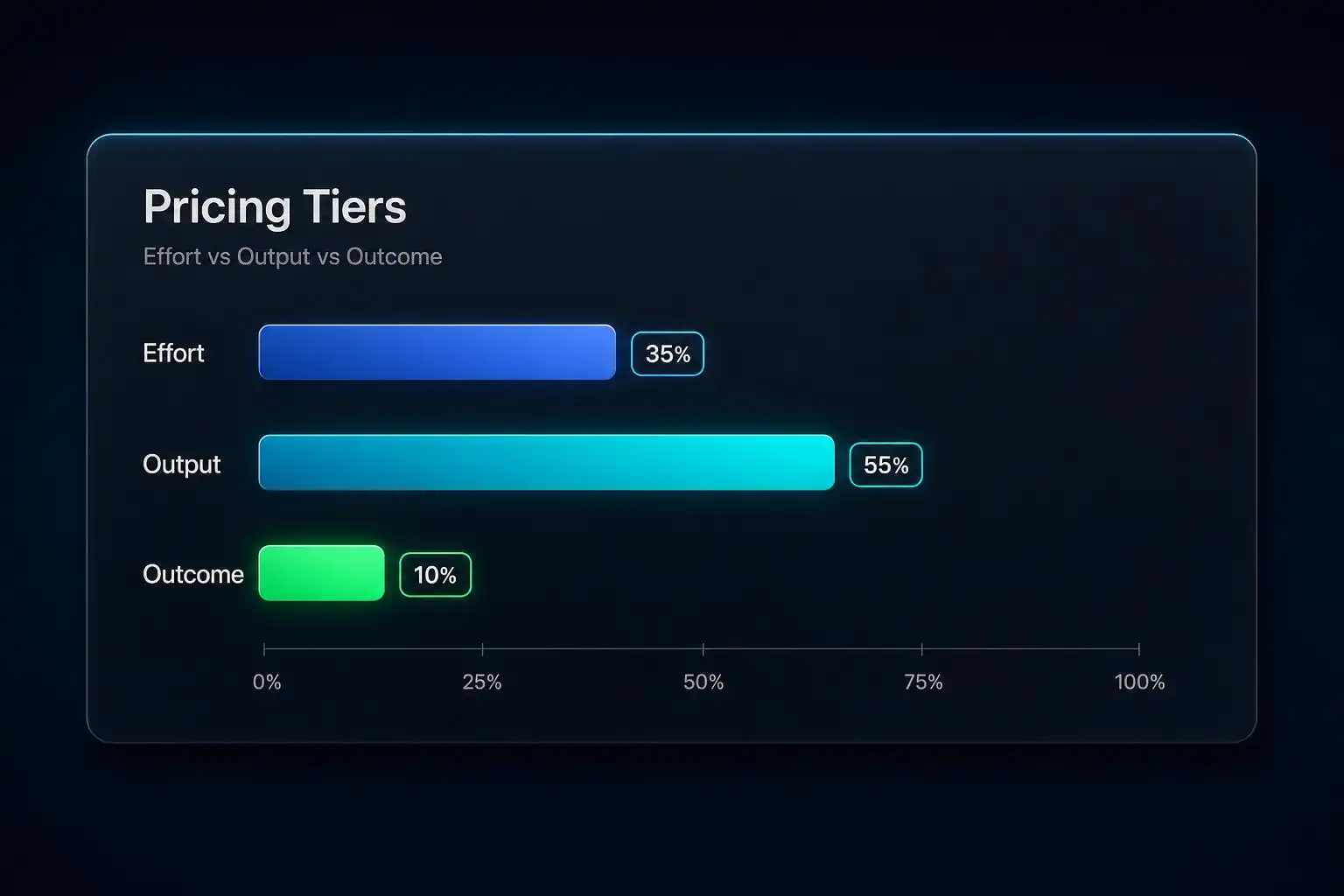
Everyone says they’re moving toward outcome-based pricing. Investors love it. Customers say they want it. And yet, when you look at what’s actually being metered, the reality is far messier. A Bain & Company analysis of roughly 200 B2B SaaS companies found that only about 10% of AI-native companies and seat-based SaaS companies introducing AI meters actually rely on outcome-based pricing. The rest split between effort-based meters (~35%) and output-based meters (~55%).[1] That’s not a rounding error. That’s the entire market mislabeling what it’s doing.
And the mislabeling matters — not just semantically, but economically. If you’re charging for outputs and calling them outcomes, you’re building a pricing model on a foundation that will crack the moment a customer asks the obvious question: did this actually work?
The Three-Layer Stack You Need to Understand
Let me be precise about the hierarchy, because the terms get sloppy fast.
Effort-based pricing charges for what the AI consumes — tokens, compute cycles, agent hours, API calls. You’re essentially renting the machinery. The customer bears all the risk of whether the machine produces anything useful.
Output-based pricing charges for what the AI produces — a generated summary, an updated record, a recommended lead, a completed draft. Something happened. Something was created. But whether that thing moved the needle for the customer is still an open question.
Outcome-based pricing charges for a business result — a customer issue resolved, fraud recovered, a deal closed, a qualified lead that converted. The distinction between output and outcome is razor-sharp once you see it: a recommended lead is an output; a qualified lead that enters a sales pipeline is an outcome. An updated record is an output; a completed business process is an outcome.[1]
The gap between those two things — output and outcome — is where most AI pricing goes to die.
Why Founders Default to Output (And Why It’s Rational, Until It Isn’t)
I want to be fair here: there are real reasons to price on outputs rather than outcomes, especially early.
Outcomes are hard to measure. If your AI agent helps close a deal, how much credit does it get versus the sales rep, the marketing campaign, the pricing concession, and the competitor’s product recall? Attribution is genuinely difficult, and customers know it. Pricing on outcomes requires instrumentation, trust, and often a level of integration into the customer’s systems that takes months to build.
Outputs, by contrast, are legible. You can count them. You can put them on an invoice. “You generated 1,400 summaries this month” is a sentence that survives a finance team’s scrutiny. It’s auditable. It’s clean.
But here’s the trap: output pricing optimizes for production, not value. And when customers start noticing that they’re paying for outputs they didn’t use, or outputs that didn’t translate into anything meaningful, the pricing model becomes adversarial. You’re now in the business of defending line items instead of demonstrating ROI.
The usage-based model, at its best, ties price directly to the value a customer receives — which is why it’s worked so well for infrastructure players like AWS, Snowflake, and Twilio.[7] But “value received” in infrastructure is relatively easy to proxy — data stored, messages sent, compute consumed. In agentic AI, the proxy problem is much harder. Tokens consumed and tasks completed are terrible proxies for business value when the AI is doing knowledge work.
The Seat Hangover Is Making This Worse
Here’s the structural problem compounding all of this: most companies aren’t actually replacing seat pricing. They’re layering new meters on top of it.[1] About one in five AI-native software companies still relies mostly on per-seat licensing, often with usage entitlements bolted on. The rest are in hybrid territory — seats plus something else.
I’ve written before about the hybrid trap: the middle ground between seat and usage pricing that feels safe but actually satisfies neither the customer nor the seller. When you layer an output meter on top of a seat base, you get the worst of both worlds. Customers feel double-charged. Your revenue doesn’t scale with the value you’re actually delivering. And you’ve created a pricing structure that requires two separate justifications every renewal cycle.
The seat-plus-output hybrid is particularly dangerous because it trains customers to think of AI as an add-on cost rather than a core value driver. That framing will kill your expansion motion.
What Outcome Pricing Actually Requires
Moving to genuine outcome-based pricing isn’t just a pricing decision — it’s a product and infrastructure decision. Here’s what it demands:
1. A measurable business event you can own. You need to identify a result that is (a) clearly attributable to your product, (b) measurable without requiring the customer to do significant extra work, and (c) valuable enough that the customer will pay a meaningful amount per occurrence. “Issue resolved” works if you own the resolution workflow end-to-end. “Revenue influenced” doesn’t work if you’re one of twelve touchpoints.
2. Deep workflow integration. Outcome pricing requires you to be close enough to the customer’s actual business process to know when an outcome has occurred. That means integrations, data access, and often a level of trust that takes time to build. It’s not a pricing page decision — it’s an architecture decision.
3. A risk-sharing conversation. When you price on outcomes, you’re implicitly telling the customer that you’re confident enough in your product to bet on it. That’s a powerful signal. But it also means you need to have a clear conversation about what counts as an outcome, what happens when the AI fails, and how edge cases are handled. This conversation is uncomfortable, but it’s also the conversation that builds the deepest customer relationships.
4. The right product position in the workflow. Bain’s research notes that the choice between effort, output, and outcome pricing depends significantly on where the product sits in the customer’s workflow.[1] If you’re upstream (generating inputs for human decision-makers), output pricing may be the honest choice. If you’re downstream (executing decisions and closing loops), outcome pricing is both more honest and more defensible.
The Honest Middle Ground
Not every product can or should price on outcomes today. If you’re still building toward deep workflow integration, if your attribution story isn’t clean, if your customers aren’t yet willing to share the data you’d need to verify outcomes — then output pricing may be the right interim position.
But call it what it is. Don’t dress up output pricing as outcome pricing and expect customers not to notice. The CFOs reviewing your invoices are getting smarter about this distinction every quarter.
The more honest framing is to treat your current pricing as a stepping stone. Price on outputs now, but build the instrumentation and integration that will let you price on outcomes in 12-18 months. Make that roadmap explicit with your best customers. It signals confidence in your product and gives them a reason to deepen the relationship.
The companies that will win the AI monetization game aren’t the ones with the cleverest pricing page. They’re the ones that can look a customer in the eye and say: we charge for results, and here’s exactly how we measure them. That’s a harder sentence to earn than it looks. But it’s the only one that compounds.
References
- AI Pricing: A Reality Check on Effort, Usage, and Outcomes — https://www.bain.com/insights/ai-pricing-a-reality-check-on-effort-usage-and-outcomes
- Subscription-based pricing is dead: Smart SaaS companies are shifting to usage-based models — https://techcrunch.com/2021/01/29/subscription-based-pricing-is-dead-smart-saas-companies-are-shifting-to-usage-based-models



Leave a Reply