

Most SaaS pricing pages fail for a deceptively simple reason: they show prices, but they do not explain who each price is for.
That distinction matters more now because SaaS pricing has become multidimensional. You are no longer choosing between “per seat” and “usage-based” as if they are opposing religions. You are deciding how to combine access, value, usage, risk, support, and geography into a system a buyer can understand in under thirty seconds.
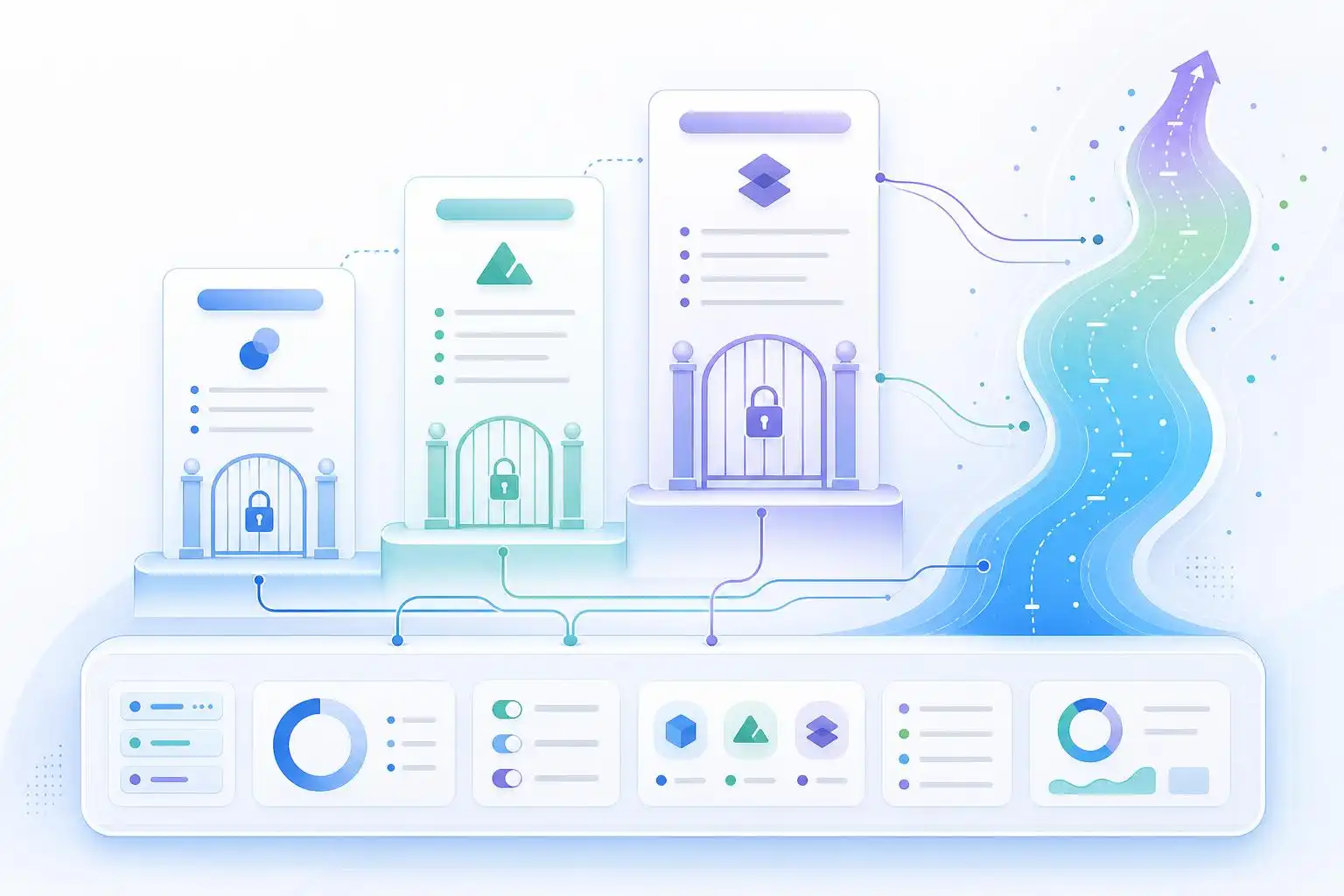
The market is moving in that direction already. Paddle’s recent pricing research notes that successful SaaS companies, especially in AI, are increasingly using hybrid models that combine a base subscription with usage-based components, giving the company predictable recurring revenue while preserving upside as customer consumption grows.[1] Lago makes the same point from the billing infrastructure side: modern SaaS companies are combining subscriptions, pay-as-you-go, prepaid credits, user dimensions, feature tiers, and usage thresholds because one pricing axis rarely matches how value is actually created.[3]
But the lesson founders should take from this is not “make pricing more complex.” It is the opposite: your internal pricing logic can become more sophisticated only if your external packaging becomes clearer.
The pricing page is now a segmentation interface
A good pricing page used to answer one question: “How much does this cost?”
A good pricing page now answers three:
- “Which plan is for me?”
- “What happens when I grow?”
- “Can I predict my bill?”
If your pricing page cannot answer those questions, customers will do what customers always do when asked to decode vendor logic: they delay, ask sales, under-buy, or churn later when the invoice surprises them.
This is especially dangerous in AI SaaS, developer tools, data products, and infrastructure-adjacent software. Usage may vary wildly across customers. Cost to serve may be lumpy. One customer’s “small team” may run millions of API calls; another customer’s “enterprise department” may barely touch the product after onboarding. A flat plan hides that variance. Pure consumption pricing exposes too much of it. Hybrid pricing exists because both sides want protection: the vendor wants a revenue floor, and the customer wants a bill that does not behave like a slot machine.
That does not mean every company needs five plans, three meters, credits, overages, and a pricing calculator. It means every company needs an explicit segmentation system.
Segment first, then choose the model
One of the most common mistakes I see is model-first pricing:
- “Should we be usage-based?”
- “Should we charge per seat?”
- “Should we copy Notion’s tiers?”
- “Should we add credits because OpenAI has credits?”
Those are implementation questions. The first question is: whose willingness to pay are you trying to capture, and what makes it different from someone else’s?
Paddle’s data is a useful reminder that willingness to pay is not only a company-size issue. It also varies materially by region: their benchmark found Nordic customers paying 28% more than US prices on average, while Brazilian customers paid 12% less.[1] That does not mean you should blindly uplift Scandinavia and discount Brazil tomorrow morning. It does mean that “one global USD price” is often a convenience for the vendor, not a reflection of the market.
Segmentation can come from several places:
- Company size: freelancer, team, department, enterprise.
- Use case: internal productivity, customer-facing workflow, compliance-critical operation.
- Usage intensity: occasional, steady, spiky, high-volume.
- Value realized: time saved, revenue generated, risk reduced, infrastructure replaced.
- Procurement needs: self-serve card, invoice, security review, legal negotiation.
- Geography: purchasing power, tax treatment, currency expectations, local alternatives.
Your pricing model should be downstream of those differences. If your primary value expands with users, seats may be the right base. If your value expands with transactions, records, tokens, messages, minutes, or compute, a meter may be necessary. If your value expands with organizational complexity, feature-based tiers and enterprise packaging matter more than raw consumption.
Stripe’s SaaS pricing guidance makes this lifecycle point well: pricing should not focus only on acquisition; tiers and feature gates should support expansion, retention, and long-term customer success.[6] In other words, the plan a customer chooses today should make the next plan feel inevitable, not punitive.
The best hybrid models have one primary story
Hybrid pricing gets messy when companies try to tell three stories at once.
A plan says: “Pay per user.”
A usage table says: “Actually, pay per event.”
An add-on says: “Actually, the valuable feature is separate.”
The enterprise box says: “Actually, contact us and forget everything above.”
That is not hybrid pricing. That is unresolved positioning.
A strong hybrid model has one primary story and one secondary adjustment.
For example:
- Collaboration product: “Pay for seats; heavy automation usage may create overages.”
- AI workflow tool: “Pay for a workspace subscription; AI credits scale with output.”
- API platform: “Commit to a monthly minimum; usage above the included volume is metered.”
- Data product: “Choose a feature tier; data volume determines the infrastructure add-on.”
- Enterprise automation platform: “Pay for platform access; premium workflows and managed services are packaged separately.”
The customer should be able to describe the pricing back to you in one sentence. If they cannot, your model may be economically clever but commercially weak.
Lago describes hybrid pricing as combining two or more approaches, such as subscriptions, pay-as-you-go, and tiers, to balance predictability with flexibility.[4] The operative word is “balance.” A hybrid model should reduce anxiety for both parties. If it creates more anxiety, it is not doing its job.
Predictability is a feature
Founders often underestimate how much buyers value predictability.
A CFO does not love a pure usage-based bill just because it is “fair.” A team lead does not love explaining to finance why the product that cost $800 last month costs $4,700 this month. A developer does not love instrumenting cost controls before they have even proven the use case.
Usage-based pricing can be excellent when consumption maps tightly to value. It lowers entry barriers and allows revenue to scale with customer success. But it also transfers forecasting work to the customer. That is why pay-as-you-go models often evolve into negotiated enterprise contracts as usage grows.[7]
The pricing strategist’s job is to decide where predictability belongs.
Common tools include:
- Included usage: “Your plan includes 100,000 events.”
- Soft limits: “We will notify you before overages.”
- Hard caps: “Usage pauses unless you approve more.”
- Prepaid credits: “Buy a block of capacity and draw it down.”
- Minimum commitments: “Commit to a baseline in exchange for better rates.”
- Volume discounts: “Your unit price declines as usage grows.”
- Annual true-ups: “We reconcile expansion periodically, not every billing cycle.”
These mechanics are not just billing details. They are packaging psychology. They tell customers whether your company is trying to partner with them or ambush them.
Feature tiers still matter
In the rush toward usage-based and AI-driven pricing, some founders have started treating feature tiers as old-fashioned. That is a mistake.
Feature tiers remain one of the cleanest ways to separate willingness to pay, especially in B2B. A startup and an enterprise may use the same number of records, but they do not need the same procurement support, security controls, admin permissions, audit logs, SLAs, implementation help, or account management. Paddle’s B2B guidance notes that business customers care about ROI, efficiency gains, and solving expensive problems, and that higher tiers should often reflect support, documentation, implementation help, and dedicated account management.[1]
That is why “enterprise features” are not merely features. They are risk reducers.
A security review is not a product capability in the same way a dashboard is. It is a purchase enabler. SSO, SCIM, audit logs, role-based permissions, data residency, contractual SLAs, and premium support all exist because larger customers have more to lose. They are not paying only for software. They are paying to make the purchase defensible.
Paddle’s broader pricing resources argue that SaaS pricing should be based on the value customers receive rather than development costs or competitor mimicry, and they often recommend tiered pricing because it creates fixed packages for different buyer needs.[5] That recommendation still holds, but with a caveat: tiers must be value narratives, not arbitrary bundles.
A weak tier says: “Pro includes 17 more things.”
A strong tier says: “Pro is for teams standardizing this workflow across a department.”
Billing infrastructure can constrain strategy
There is an unglamorous reason many SaaS companies avoid better pricing: their billing system cannot support it.
They can imagine the model. They can sell the model. They can sketch the pricing page. But then someone asks whether the billing stack can handle prepaid credits, mid-cycle upgrades, usage thresholds, regional pricing, annual commitments, custom contracts, tax-inclusive pricing, or real-time usage previews.
Suddenly the “pricing strategy” becomes a six-month engineering project.
Lago’s usage-based billing overview points out that modern systems often need to handle multiple pricing dimensions at once: time-based billing periods, volume-based usage, feature-based access, and user-based dimensions.[3] Their pay-as-you-go guidance also warns that teams frequently underestimate the technical debt of building and maintaining custom usage-based billing, including delays, errors, and compliance risk.[7]
This is where pricing strategy becomes operational strategy. If finance cannot reconcile it, sales cannot explain it, support cannot debug it, and customers cannot verify it, the model is not ready.
Before launching a more sophisticated model, ask:
- Can customers see their usage before the invoice arrives?
- Can sales quote the model without a spreadsheet ritual?
- Can finance recognize revenue cleanly?
- Can customer success identify accounts approaching limits?
- Can product instrument the right events reliably?
- Can the billing system support exceptions without manual chaos?
- Can the pricing page show enough detail to build trust without overwhelming the buyer?
If the answer is no, simplify the model or upgrade the infrastructure before you put the burden on customers.
Regional pricing is not just localization
Regional pricing often gets treated as a late-stage optimization: something you do after product-market fit, after international traction, after everything else.
I think that is increasingly wrong.
If your product is self-serve and global from day one, your pricing page is already making a regional pricing decision. The only question is whether you made it intentionally.
Regional willingness-to-pay differences can mean you are underpricing high-WTP markets and overpricing lower-WTP markets simultaneously.[1] That does not require hyper-granular country-by-country experimentation at seed stage. But it does argue for paying attention to currencies, tax display, local purchasing power, and payment preferences earlier than many founders do.
There is also a trust component. A buyer who sees local currency, clear tax treatment, and a price that feels plausible in their market experiences less friction than one forced to mentally translate USD plus unknown taxes. That friction is invisible in your pricing strategy deck, but very visible in conversion data.
A practical framework: floor, fence, and flex
When founders ask me how to design a modern SaaS pricing system, I often use three words: floor, fence, flex.
1. Floor
The floor is your predictable revenue base. It might be a subscription, platform fee, minimum commitment, or annual contract.
The floor answers: “What does it cost to be a customer at all?”
A good floor covers baseline value, support burden, infrastructure readiness, and the right to access the product. It should not be so high that it blocks adoption, but it should be high enough to avoid filling your customer base with accounts that can never become profitable.
2. Fence
The fence separates segments. It might be feature access, seat count, usage limits, support level, compliance needs, admin controls, or contract terms.
The fence answers: “Why is this customer on this plan rather than another?”
Good fences are intuitive. Bad fences feel like ransom. If customers perceive your gating as withholding essential value, they resent the upgrade. If they perceive it as matching increased complexity, they accept it.
3. Flex
The flex is the variable component. It might be overages, credits, transaction fees, token usage, API calls, compute hours, message volume, or data processed.
The flex answers: “What happens when value or cost scales?”
Good flex aligns expansion revenue with customer success. Bad flex punishes adoption or creates invoice fear.
The model works when all three parts are visible:
- Floor: “Start here.”
- Fence: “Upgrade when your organization becomes more complex.”
- Flex: “Scale usage without renegotiating every time.”
That is the pricing page your buyer wants.
The mistake to avoid: monetizing everything
Once a company discovers meters, it is tempting to meter everything.
Do not.
A meter should track a value axis the customer understands and accepts. If customers cannot predict it, cannot control it, or do not believe it maps to value, it will feel like a tax. This is especially important in AI products where internal cost drivers, such as model calls or tokens, may not match the customer’s mental model of value.
Customers do not want to buy your cost structure. They want to buy an outcome they can justify.
So before adding a meter, ask:
- Does usage correlate with value received?
- Does usage correlate with cost to serve?
- Can the customer estimate usage before buying?
- Can the customer monitor and control usage after buying?
- Does the meter create healthy expansion, or does it discourage adoption?
- Would a tier limit, credit bundle, or add-on communicate value more clearly?
If a meter passes those tests, use it. If not, hide the complexity behind packaging.
The new standard is sophisticated underneath, simple on the surface
SaaS pricing is not becoming simpler operationally. The stack is moving toward hybrid models, regional experiments, real-time usage data, prepaid credits, feature gates, enterprise contracts, and lifecycle-based expansion paths.
But the buyer experience still has to feel simple.
That is the central tension of modern pricing: complexity is moving into the system so clarity can remain on the page.
The winners will not be the companies with the most elaborate pricing architecture. They will be the companies that know exactly which customers they serve, how those customers perceive value, where usage should scale the bill, where predictability should cap it, and how to explain the whole thing without making the buyer work.
Your pricing page does not need another toggle.
It needs a segmentation system your customers can recognize themselves in.
References
- SaaS Pricing Models and Strategies — https://www.paddle.com/blog/saas-pricing-models-strategies-fltr
- SaaS Usage-Based Billing: Per-Seat, Metered, and Hybrid Models — https://getlago.com/blog/saas-usage-based-billing-models
- What are hybrid pricing models and how do they work? — https://getlago.com/blog/hybrid-pricing-models
- SaaS Pricing Models, Guides & Strategies — https://www.paddle.com/resources/saas-pricing-models
- SaaS Pricing Models: A Guide — https://stripe.com/resources/more/saas-pricing-models-101
- Understanding the Pay-as-You-Go Pricing Model for SaaS Businesses — https://getlago.com/blog/pay-as-you-go-pricing



Leave a Reply