

The first cloud version of an open-source product is usually born from a reasonable sentence: “Some users don’t want to run this themselves.”
That sentence is true. It is also dangerously incomplete.
If your commercial offer is only “we host the thing you can already host,” you have not built a product. You have built an operational favor. Favors can produce early revenue, especially from teams with more budget than patience, but they rarely create a durable business. The customer will compare your price to their infrastructure bill, their platform team’s hourly rate, or the cheapest contractor who can run Kubernetes without crying in public.
A managed cloud business needs a stronger reason to exist. It must make the customer better off in ways that are hard to recreate with the free version plus a weekend and a Terraform module.
The hosting tax is not enough
Open-source founders often underestimate how quickly “managed hosting” becomes a commodity in the buyer’s mind. Internally, you know the work involved: upgrades, backups, monitoring, capacity planning, incident response, compatibility testing, security patching, cloud account weirdness, and the ongoing emotional damage caused by DNS.
The buyer does not see most of that. They see a monthly line item.
If the paid offer is framed as a hosting tax, customers will keep asking some version of the same question: “Why is this so expensive when the software is free?” That is the wrong argument to be trapped in. You will start defending your margins using the language of infrastructure cost, which is the lowest-margin language available.
The better question is: “What business outcome becomes simpler, safer, or faster because we run this for you?”
That answer may include hosting, but it should not end there.
Managed should mean opinionated
A good cloud product is not merely the open-source distribution installed on someone else’s machines. It is the same core technology wrapped in decisions.
Which defaults are safe? Which integrations are pre-wired? Which metrics matter? Which alerts are noise? Which upgrade path will not surprise a compliance team? Which failure modes should the customer never have to learn about?
This is where commercial value lives: not in hiding the free product, but in absorbing the judgment required to operate it well.
Most users do not want infinite configurability. They want to know that someone who has seen hundreds or thousands of deployments has encoded the best path. Your cloud should feel like the most competent version of your project, not the most restricted one.
This distinction matters. A hostile cloud says, “Pay us because we made self-hosting painful.” A valuable cloud says, “Pay us because we made production boring.”
Do not cripple the open-source version to create cloud demand
One of the most common mistakes in open-core strategy is trying to make the free version artificially annoying. The theory is simple: if self-hosting hurts enough, people will pay for the managed version.
In practice, this creates resentment before it creates revenue.
Developers can smell intentional friction. If your documentation is vague, your deployment process is fragile, or basic operational features are withheld in a way that makes the project feel unsafe, the community does not conclude that your cloud is premium. They conclude that the maintainers are playing games.
You do not need to make open source bad to make cloud good. In fact, you usually need the opposite. A healthy open-source project is the trust engine for the commercial product. It proves the technology works. It creates familiarity. It lets internal champions experiment before procurement wakes up. It gives buyers confidence that they are not adopting a dead-end proprietary system dressed in open-source clothing.
The self-hosted version should be good enough to win belief. The cloud version should be good enough to win budget.
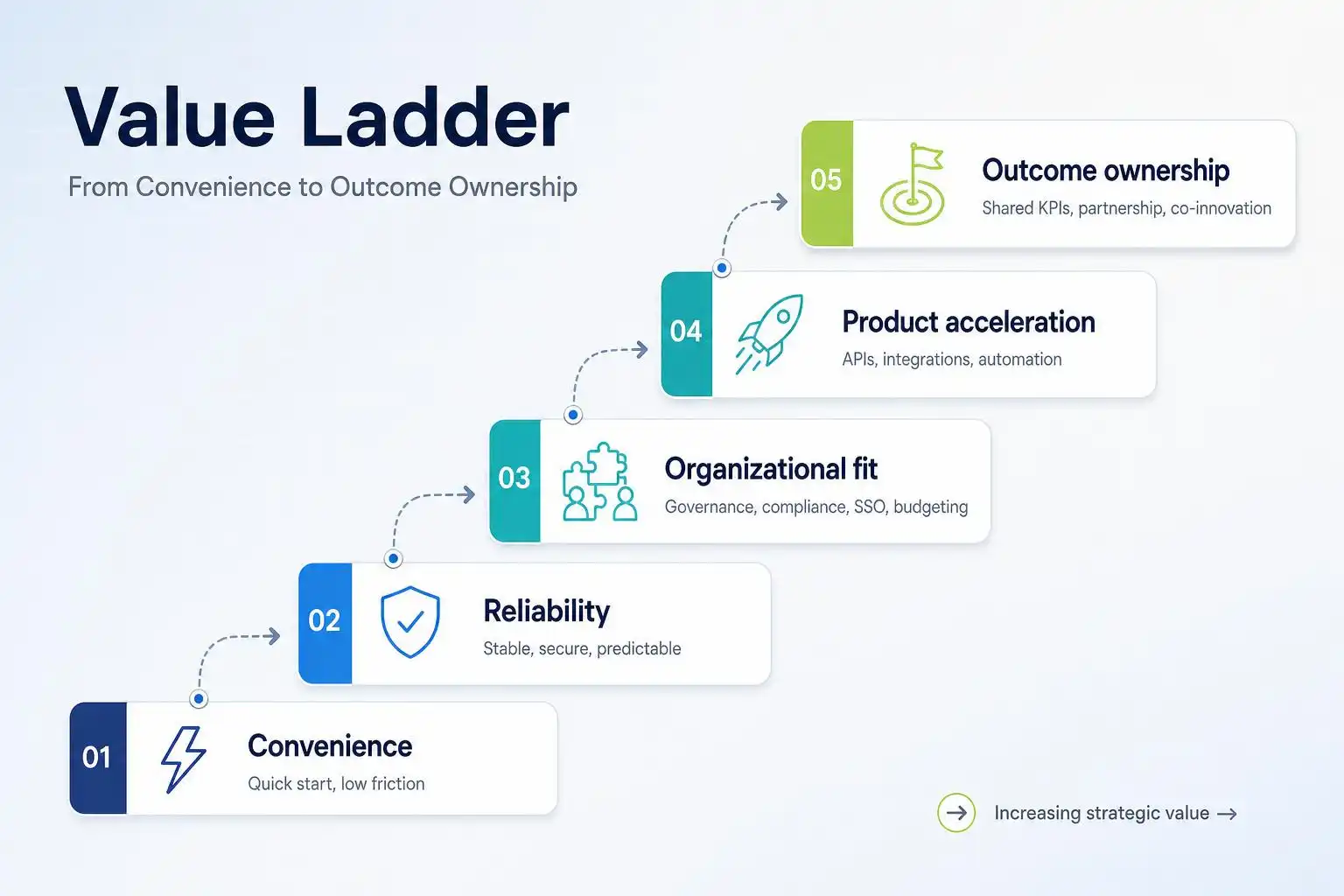
The cloud value ladder
When I look at open-source companies trying to sell a managed service, I usually place the offer on a simple ladder.
Level one: convenience. The customer does not need to install, patch, or monitor the software. This is useful, but easy to compare against infrastructure cost.
Level two: reliability. The customer gets backups, uptime commitments, incident response, safe upgrades, performance tuning, and disaster recovery. This is stronger because you are selling reduced operational risk.
Level three: organizational fit. The product includes SSO, audit logs, role-based access control, data residency, private networking, compliance artifacts, and admin workflows. Now you are selling adoption inside a serious company.
Level four: product acceleration. The cloud includes capabilities that are only possible, or dramatically better, in a managed environment: cross-workspace analytics, global coordination, hosted model endpoints, managed connectors, benchmarking, collaborative workflows, or automated optimization based on fleet-wide operational knowledge.
Level five: outcome ownership. The customer is not buying software or hosting. They are buying a result: lower latency, fewer failed jobs, faster deployments, cleaner data pipelines, reduced security exposure, or higher developer productivity.
Many companies launch at level one and wonder why expansion is hard. The real money is usually made between levels three and five.
Where the open-core line belongs
The hardest product decisions are not technical. They are moral and commercial at the same time.
What belongs in the open-source project? What belongs in paid cloud? What belongs in both?
My rule of thumb is this: keep the core engine, developer experience, and credible self-hosting path open. Charge for scale, coordination, governance, and managed outcomes.
That means the free version should let a capable team run the software and get real work done. It should not be a demo pretending to be a community edition. But the paid version can reasonably include features that become valuable when the software moves from an individual or small team into a company with risk, process, and accountability.
Examples include:
- Centralized administration across multiple teams or workspaces
- Advanced audit trails and compliance reporting
- Enterprise identity and access management
- High-availability managed infrastructure
- Usage controls, quotas, and cost governance
- Premium hosted integrations with third-party systems
- Automated upgrades with compatibility guarantees
- Priority incident response tied to business impact
This line is easier to defend because it maps to customer value. You are not charging for the right to use the project. You are charging for the ability to use it safely at organizational scale.
Beware the “enterprise feature junk drawer”
There is another trap: assuming every paid feature must be boring enterprise plumbing.
Yes, SSO and audit logs matter. In many markets, they are table stakes. But if your entire paid plan is a checklist of procurement features, you may win the security review and still lose the champion.
The buyer who loves your open-source project wants the paid product to make their life meaningfully better. They want fewer escalations, faster onboarding, cleaner workflows, better visibility, and less time explaining to leadership why a critical internal system is held together with shell scripts.
So package enterprise controls with product magic. The best commercial features do both: they satisfy the organization and delight the practitioner.
For example, an audit log is a compliance feature. But an audit log that explains what changed, who approved it, what risk it introduced, and how to roll it back is also a product feature. Usage limits are an admin feature. Usage limits with forecasting, anomaly detection, and team-level recommendations become a budget owner’s best friend.
The difference is whether you are selling permission to deploy or confidence after deployment.
Pricing should follow the customer’s mental model
Managed open-source products often struggle with pricing because they inherit two competing expectations. Developers expect free access because the project is open. Businesses expect to pay when something becomes critical.
The bridge between those expectations is a metric that reflects value without punishing adoption.
Seat-based pricing works when collaboration, governance, or individual productivity is the main value driver. Usage-based pricing works when consumption maps clearly to customer outcomes, such as jobs run, data processed, environments managed, or requests served. Hybrid pricing can work well when there is a platform component plus variable usage.
What usually fails is pricing that makes the customer afraid to use the product. If every experiment creates surprise cost, your cloud becomes a meter running in the background. That is especially dangerous for open-source companies, because the user always has an escape hatch: they can go back to self-hosting, even if it costs them time.
Good pricing says, “As you get more value, we participate.” Bad pricing says, “As you explore, we punish you.”
Your best cloud customers are not failed self-hosters
A subtle but important point: the ideal managed customer is not always someone who tried self-hosting and gave up.
Some of your best customers will be perfectly capable of running the software themselves. They will pay you anyway because their engineering time is more valuable elsewhere, because they want the vendor on the hook, or because internal ownership is politically expensive.
Do not market only to helplessness. Market to leverage.
The message is not, “This is too hard for you.” The message is, “You have better things to do than become experts in our operational edge cases.”
That framing respects the customer. It also respects the community. Many open-source users are extremely sophisticated. Treating them as incapable is both inaccurate and commercially unwise.
The promise you are really making
When someone pays for your cloud, they are not just buying uptime. They are transferring a slice of responsibility.
They are trusting you to know what good looks like. They are trusting you to notice problems before they do. They are trusting you to make the upgrade path less frightening, the security posture less ambiguous, and the future of the project less uncertain.
That is a serious promise. It deserves a product strategy deeper than “hosted version available.”
The strongest open-source cloud businesses do not monetize inconvenience. They monetize confidence, scale, and accumulated operational wisdom. They keep the open project useful enough to earn trust, and they make the paid product valuable enough that choosing it feels like good judgment rather than surrender.
Your cloud is not the product because the servers are yours. It becomes the product when the customer can finally stop thinking about the servers at all.



Leave a Reply